
China's Piano Casks
How Chinese oak is changing whisky’s tune
November 27, 2026 –––––– Jonny McCormick
Chinese oak (Quercus mongolica) is prized for its distinctive aromatic profile and its ability to impart fragrant spices, incense-like notes, and woody complexity to whisky. The harsh growing conditions in the Changbai Mountains in northeast China produce slow-growing, irregular timber prone to twists, knots, cracks, and wormholes. As China’s whisky industry expands, the need for a scalable cooperage solution using local materials has become a challenge.
The primary purpose of a cask is to hold liquid, but much of that depends on the number of tyloses in the wood. These natural structures seal internal channels and help make casks watertight, yet not all oak species contain tyloses in the same abundance. American oak is rich in tyloses, allowing quarter-sawing (where logs are cut into quarters, then sawn into planks perpendicular to the outside edge of the quarter) and reliance on the wood’s natural sealing abilities. European oak contains fewer tyloses and can be rift-sawn (where logs are cut at 30°–60° angles, like slicing a pizza), which interrupts leakage pathways and improves structural integrity. With an exceptionally low number of tyloses, Chinese oak presents an entirely different challenge: Neither traditional quarter-sawing nor rift-sawing provides an ideal solution for working with it; the former leaks too readily, while the latter sacrifices so much timber that production becomes commercially unviable.
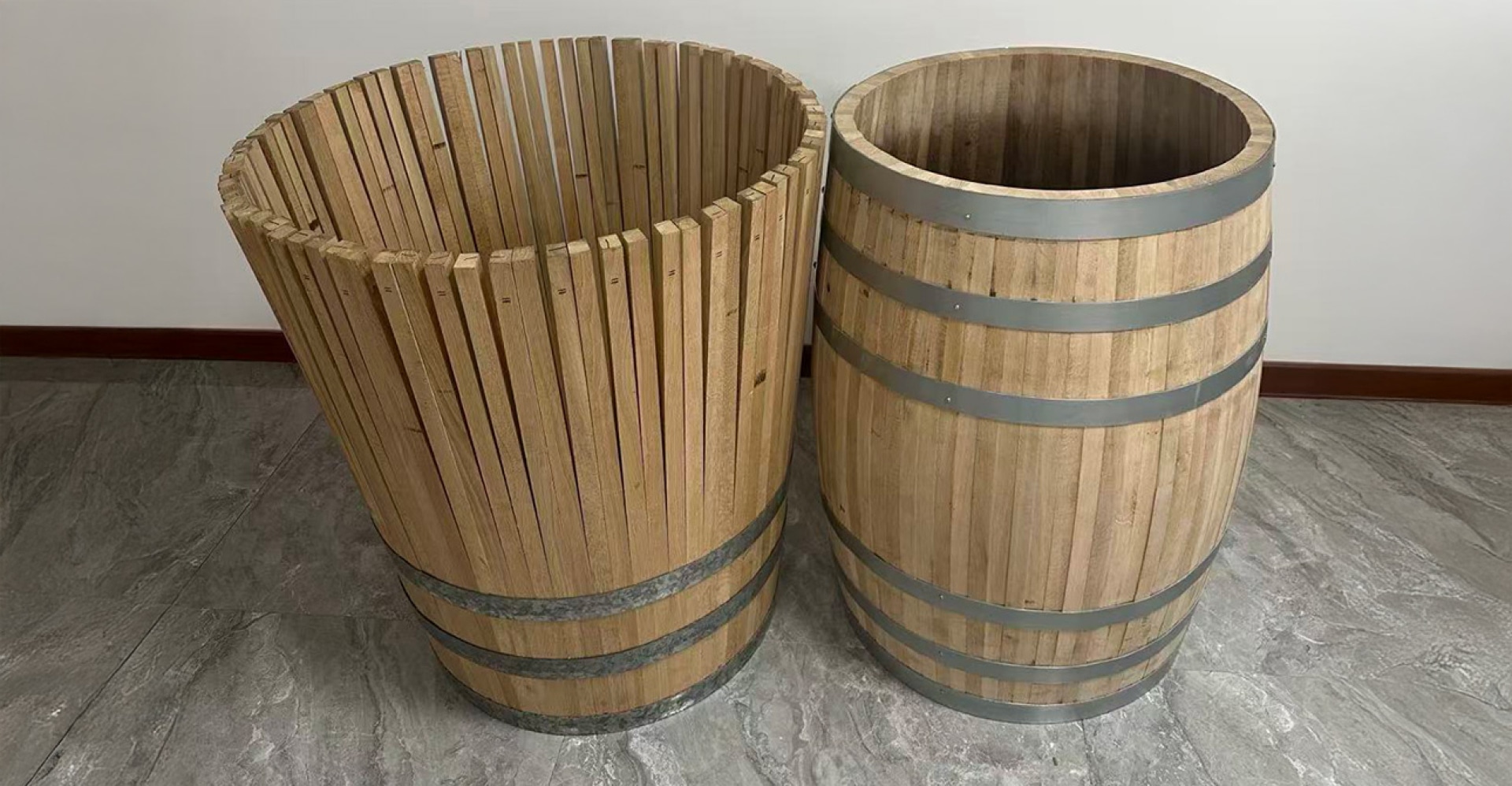
In Shandong Province, Wolin Cooperage first brought Chinese oak casks to market in 2019, but to overcome the wood’s tendency to leak, the coopers had to abandon conventional wisdom. Chuan Distillery, owned by Pernod Ricard, entered a partnership with the cooperage to devise a custom narrow-stave construction. The principle is simple but innovative: The cask’s ability to hold liquid depends less on the properties of the oak itself and more on how the cask is assembled. Instead of relying on tyloses to block internal channels, coopers cut the oak into unusually narrow staves, about the width of a white piano key, typically 7/8 inch to just over an inch wide, giving rise to the name “piano casks.” These skinny staves cut off more of the leakage channels that traverse from the inner stave surface to the outer surface. As spirit penetrates the wood, the staves swell, creating expansion pressure at each joint and forming a self-sealing structure. A 220-liter piano cask may contain more than 75 staves, compared to around 30 in a conventional barrel. The technique also delivers a significant boost in yield. Traditional coopering often rejects sections of Chinese oak because defects render full-sized staves unusable. Narrow staves let coopers work around knots and imperfections, extracting usable material from sections that would otherwise be discarded as waste. The coopers then grade each stave. Fine-grained staves with denser growth rings are given a premium grade and can impart more aromas and flavors than standard staves.

The technique seems to be hitting all the right notes. Narrow-stave cooperage makes Chinese oak more watertight and more economical while preserving its distinctive flavor profile. The narrow stave technique delivers a yield of 25.5% for every 100 cubic meters of Chinese oak logs used, outperforming the yields of quarter-sawn oak at 15% and rift-sawn oak at 13%. While no Chinese oak-aged single malt whisky has been released yet, more than 800 casks are being monitored for annual evaporative volume losses, with the angels’ share cut in half from 13.2% in standard Chinese oak casks to 6.6% in piano casks.
The results have struck a chord far beyond China. While Teeling, High Coast, and Buffalo Trace have experimented with traditionally coopered Mongolian oak casks, the Chinese oak narrow-stave technique has been applied to other low-tylose oak species, including Japanese mizunara, Russian, Korean (Quercus dentata), and even lesser-known varieties previously considered unsuitable for whisky maturation. Like the piano keys that inspired its nickname, each narrow stave plays its part, proving that with the right craftsmanship, even difficult oak can make sweet music.