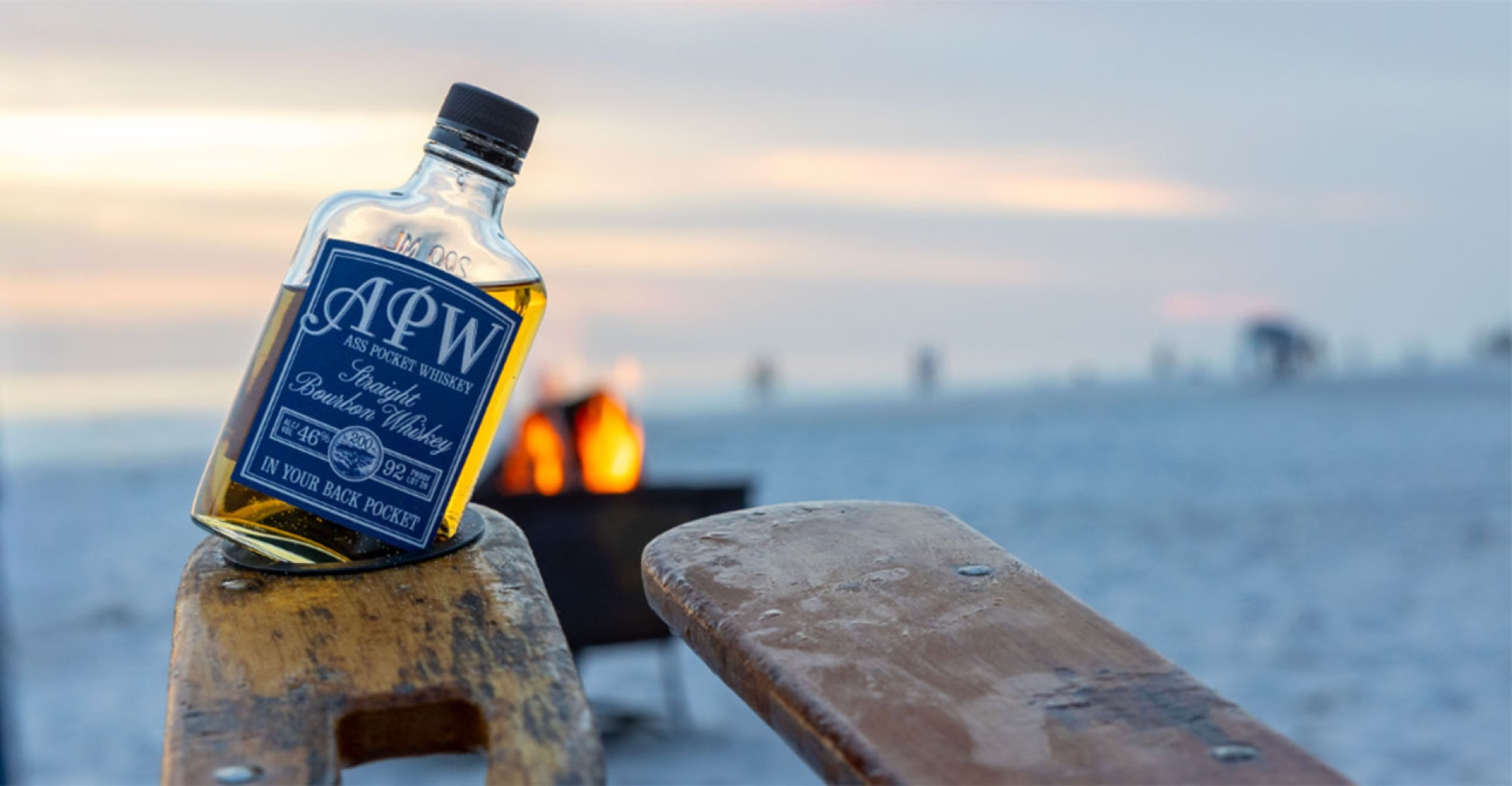

Ass Pocket Whiskey Is Six Releases In. Derek Trucks Is Just Getting Started
The Tedeschi Trucks Band co-founder on sourcing blind, proof-point obsession, and why he goes online to buy his own releases
April 14, 2026 –––––– Sean Evans
Tedeschi Trucks Band travels with a crew that fills much of the Beacon Theatre’s tight backstage space. Two hours before the sold-out show, workers scurry about, moving with purpose, determined strides, and steeled stares. Derek Trucks, however, has an unhurried lightness. He breezes into the green room, grinning at something that happened down the hall.
Settling onto the couch, he grabs two bottles of Ass Pocket Whiskey (APW) Original—his new 7-year, 92-proof, always-on Straight Bourbon—and extends one my way. “A little preshow,” he says, cracking it. “Cheers, man.”
For the duration of our interview, the only time he’s not smiling is when he’s taking a swig. Most of his sentences end with a chuckle or a belly laugh, and this affable energy is infectious. Within minutes, you’ve forgotten you’re sitting with a man who’s made Rolling Stone’s best guitarists list—twice—ninety minutes before he walks out to a few thousand people in one of the most iconic New York City venues to play two sets.
Also immediately obvious: Trucks knows whiskey as thoroughly as he does the slide guitar.
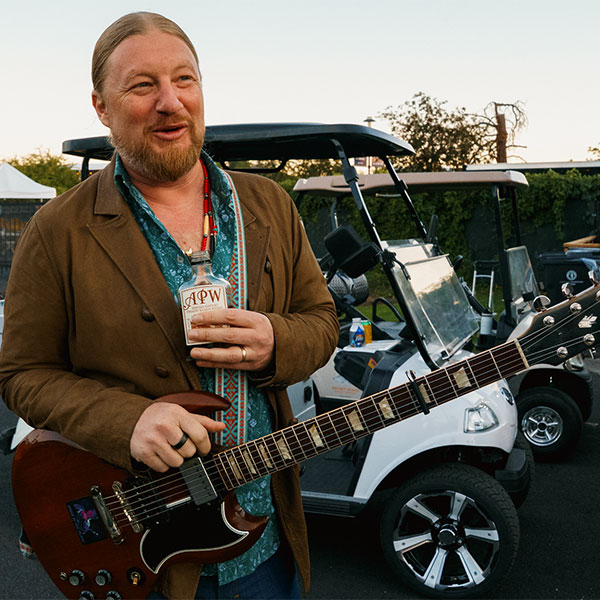
“There’s just something really American about bourbon,” he says. “Being in the deep South, there’s a handful of things that you can be proud of: whiskey and being a part of The Allman Brothers,” he laughs. “Those go hand in hand for me.” (Trucks was a member of The Allman Brothers from 1999-2014.)
Ass Pocket Whiskey, a non-distilling producer, launched in September 2024 with Release No. 1, Heritage Kentucky straight bourbon, which sold out quickly. Release No. 2 was a 122.5-proof holiday edition that dropped in November 2024 and disappeared just as fast. No. 3 was A Brotherly Release, a dual-drop he made with his brother David, two bourbons from the same distillery and mashbill that diverged through different aging environments. No. 4, The Search, came out last fall: a 10 year old, 107-proof small batch expression. The fifth release, a 20 year old cask strength Tennessee whiskey, bottled at 117.6 proof, still has a few bottles available. Five releases, all in 200-ml flasks, nearly all of which were instant sell-outs.
APW Original is the sixth release and the first that won’t vanish.
“Not everyone that drinks whiskey wants it 110 or 115 proof out of the bottle,” Trucks says. “I enjoy it. But I also enjoy a good 92 proof. Some of my favorite whiskeys of all time are late ’80s or early ’90s Old Grand-Dad, and some of those ring in at 86 or 90. I wanted to find something for the always-on that hit me that way.”
Touring through Kentucky in the early days of what would become the allocated bourbon era, he and his bandmates learned to ask the right question at the right kind of shop. “You'd find just really old stuff behind the counter, and then you learned: in the South, certain places you go, ask ‘What else you got back there?’ And sometimes they would have Old Fitz, or whatever.” He smiles at the memory. “But that game dried up 15 or so years ago. The stuff you wanted was still there, but it was suddenly a thousand dollars. You’re like, I’m not doing that anymore.”
What came next was barrel picks. He and his brother David made trips to Kentucky, tasting samples together and reliably landing on the same pours. “We always seem to land on the most expensive ones, too,” he laughs.
That calibrated palate became the backbone of APW. For every bourbon they consider, Trucks and his brother taste them blind, land on a winner, then pull samples at five or six different proof points to find where the whiskey actually wants to live.
Point of Proof
“Your palate’s always changing, but when we find a whiskey we like, we try to track down where it drinks the best. Sometimes it’s hot, sometimes it’s less hot. We had one—I think it was the 20-year—where I thought it would be better to knock it down a little bit. But there were a few proofs where it just did not sing; 117 is where it ended up, and it was bulletproof. It’s funny how different whiskeys want to be at a certain range."
APW Original went in a different direction. The 7 year old bourbon (distilled in Indiana, presumably at MGP) he found for the always-on line, “I didn't feel like it needed to be super hot. This one isn’t as sweet as the Old Grand-Dads are, but it’s a comfortable drink. One that I’ve never opened and felt like it was too much.” He says it hits all the right notes of what he prefers in a whiskey: good age, a bit of rye, with a decently long finish.
He takes a pull of APW Original and nods, like he’s still confirming his own answer. “The special releases, we take more chances, maybe put something out that might hit too hard, be too oaky. But this is good always-on bourbon.”
The “would I buy it off the shelf” test is the only quality bar that matters to him. He means it in the most literal way: Trucks goes online and buys his own releases when they drop.
“Whenever we do a release, I go online and buy about 10 two-packs. Yeah, I’m actually buying it. I like it showing up in the mail,” he grins. “When you buy a rare bottle, it’s hard to find the right time to crack it. With these, I always just throw one in my pocket. Going fishing, golfing, whatever it is, I keep one on me. I always walk on stage with one.”
That last part isn’t hyperbole. The brand’s name comes from the Delta juke joint tradition where one musician would ask another, “You got an ass pocket on you?” This was the cue to share your flask. So, when Trucks designed APW, a mandate was the 200-ml format, for portability but also to compel buyers to open the thing: “You’re more likely to drink it if it’s in a smaller bottle that you’re carrying around.”
And what is the right amount of bourbon before and during a show? “It’s not a lot. It’s a sip or two for me. I don’t want to lose my edge,” he says. “Now, after the show, that’s a different thing.”
There’s a version of this story where a famous musician launches a bourbon brand, and the whiskey is beside the point. Trucks isn’t that musician. He’s fluent in the secondary market: “Early on, we got BuffTurkey samples from three or four brokers, and I kept going, ‘This is all the same stuff; it’s good, we should get some.’” He can recount precise tasting notes from the first Michter’s 10 bourbon he tried and loved.
He’s got his own shelf in the basement of Revival Vintage Spirits and Bottle Shop in Covington, Kentucky, where his myriad purchases await pickup. Revival co-owner Brad Bonds told me that Trucks always emails him back within minutes of offering various dusties. “I’m like, ‘aren’t you playing a show tonight?!’ And Derek’s like, ‘I’m in between sets,’” says Bonds.
In a sea of underwhelming celebrity bourbon, Trucks’ APW shines brightly. His 20 year old cask strength Tennessee whiskey has all the hallmark notes of George Dickel, but Trucks wouldn’t confirm its source. APW Original is properly tasty, with enough viscosity and mouthfeel to feel substantial, at a proof that means you could, hypothetically, have most of the bottle while watching Trucks and wife Susan Tedeschi perform at the Beacon.
Trucks is already on the hunt for his ninth release—he hints that the next two are already secured, awaiting bottling in Kentucky. But “if we don’t find anything, then we don’t put anything out.” Until then, APW fans can buy Original on repeat, as a single bottle for $17 or in a three-pack for $50. “This is the one we can roll in perpetuity; that was the goal.”
Near the end of our chat, he turns the bottle over in his hands. “I love carrying one around,” he says. “I really do. It’s fun to walk into a place with good whiskey in your back pocket. Lightens the mood a little bit.”
.png?resize=410x0)