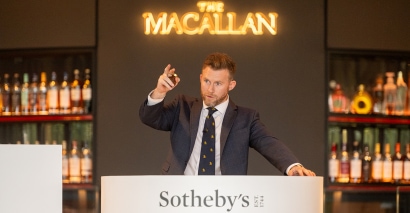
Sotheby's Whisky and Whiskey Auction, running September 3rd through the 18th, will include pre-Prohibition whiskeys. ALL PHOTOS BY SEAN EVANS

Is 146 Year Old Whiskey Drinkable? We Tried a Bottle from 1880
Sotheby's is auctioning an incredible National Distillers collection this month. We uncorked the bottles that were too far gone to sell, from Old Hermitage to an 1880 Chicken Cock
August 31, 2026 –––––– Sean Evans
“You hear that hiss?” says Zev Glesta as he jimmies the Ah So wine opener down the sides of the cork. “That’s 113 year old air escaping, baby!” The assistant vice president, whiskey North America for Sotheby’s, is jazzed. The seal on this 33 year old Chicken Cock whiskey—distilled in 1880 and bottled in 1913—held tight enough to sound off when it gave, and Glesta deftly opened five straight pre-Prohibition whiskey bottles without a single cork disintegrating, and it appears his streak will continue.
More cajoling and the sixth cork’s remnants slide free. Glesta beams, holding up his tiny foe. “There we go,” says Bill Carmean, clapping from across Sotheby’s conference table. “You can have as much as you want, Bill,” Glesta says, drizzling the motor oil-colored whiskey—the darkest I have ever seen—into a Glencairn and sliding it to Carmean. “It is your bottle…”
How a Lawyer Bought a Whiskey Dynasty’s Best for $365
In the ’80s and early ’90s, Carmean worked as a lawyer for National Distillers, shepherding them through the transition to Quantum Chemical, a sale to Jim Beam, and a merger with Hanson PLC. In 1993, Carmean ate lunch in the company’s executive dining room, “an opulent wood-paneled room, surrounded by a collection of 120 special bottles, called the National Distillers Museum of Old Bottles,” he recalls. “It was a beautiful sight.”
The new bosses didn’t agree. They wanted it gone but had no idea what it was worth. Carmean, a whiskey fan, volunteered to get it appraised. “The whole lot was assessed at $250, which felt like a steal, so I said I’d take it. They said okay, but I’d have to pay the $115 appraisal fee, too,” Carmean smirks.
And so, for $365, Carmean took possession of the 120 bottles, a third of which were made pre-Prohibition. A bunch were empty, others had such low and hazy fills, “you knew you’d get sick if you drank them,” says Carmean. He stored them with his fine wine, in an old Victorian house outside New York City.
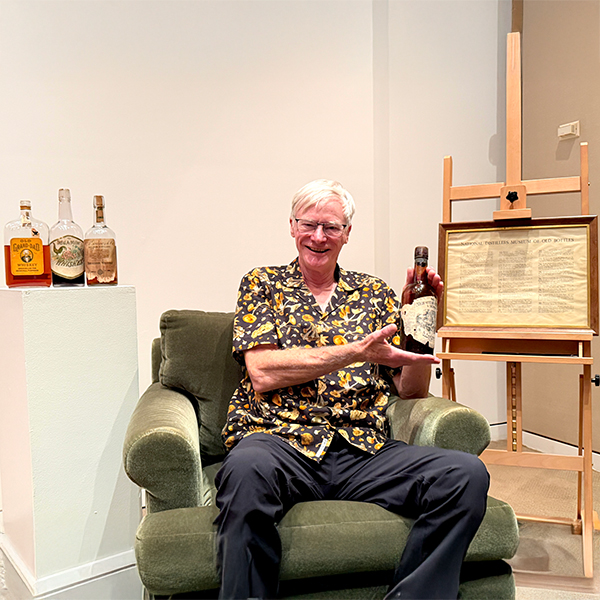
The collection became a working one. At parties, friends skipped pressuring him to open bottles and opened them themselves. “One fellow grabbed a corkscrew and opened a 1920 cognac,” Carmean laughs. “Afterward, I figured you may as well have some old bourbon so we opened one of those, too.”
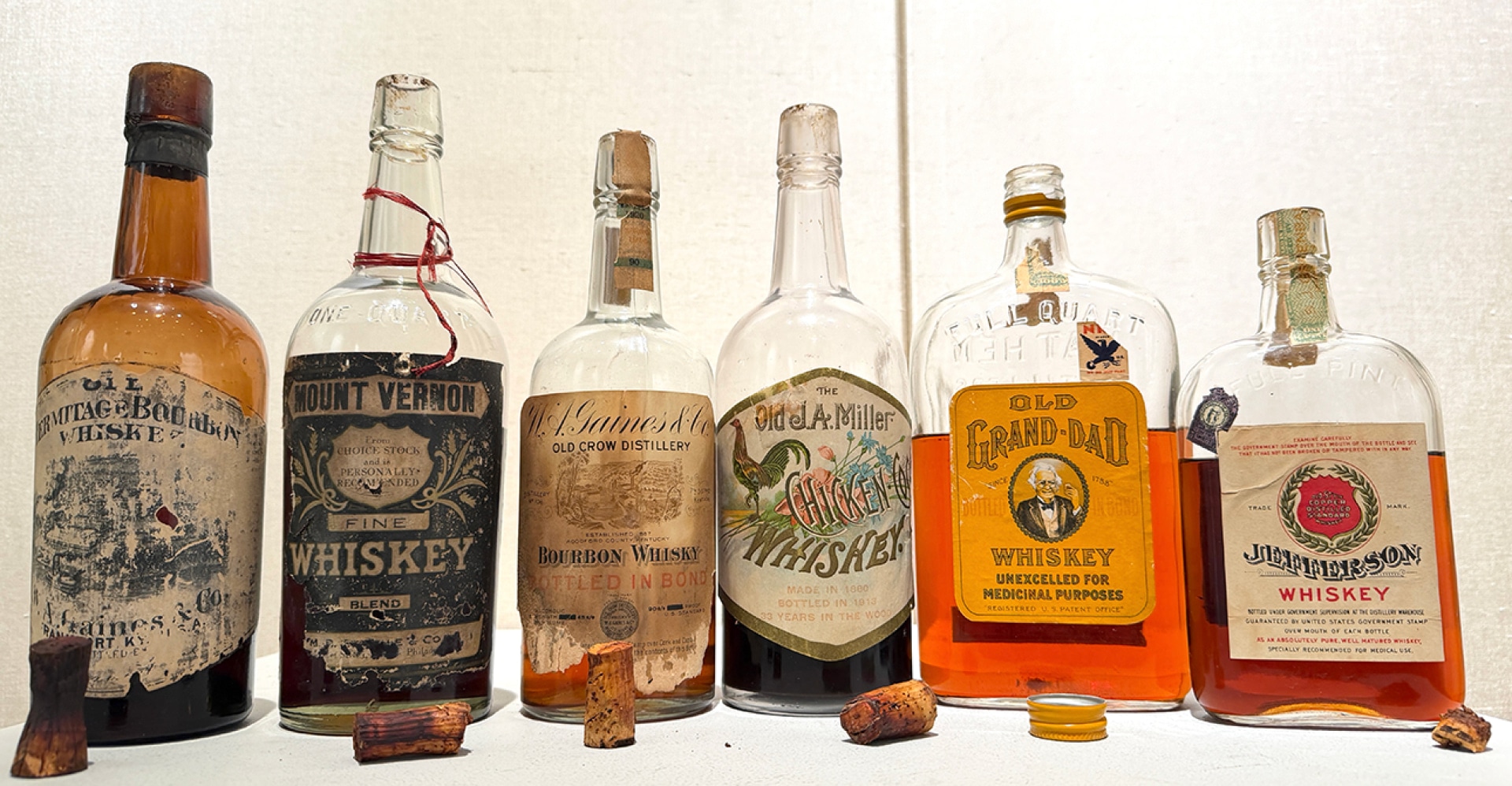
A tenth of the collection dwindled over the decades, but when Carmean and his wife wanted to move to the city, “she wanted more space, and that meant giving up some bottles,” he says. Carmean consigned 21 bottles to Sotheby's for its September 2026 Whisky & Whiskey auction. Six more missed the cut for pronounced ullage—they now loom large on our table.
Ullage kills auction value, but a bottle you can't sell is a bottle you can (gingerly) pull the cork on. So the bottles Carmean is letting me try may be 30%-plus lighter, but they’re the apex of any whiskey geek’s dream drinking list.
Inside National Distillers, the Disney of American Whiskey
There’s the 33-year Chicken Cock. And an Old Hermitage, made by W.A. Gaines in the 1880s. A Mount Vernon rye, crafted somewhere in the early 1900s, an Old Crow and Jefferson, each distilled in 1914. And a 16 year old Old Grand-Dad, distilled in 1916, bottled in 1932.
If that lineup sounds like the Oscars of pre-Prohibition whiskey, it’s because National Distillers is more a dynasty than a distillery. Its roots run back to the Whiskey Trust of the 1880s, and with a huge share of aged bourbon still in bond at Repeal, president Seton Porter made a crucial choice to keep National Distillers' high-end brands instead of chasing bottom-shelf volume.
Old Crow was the country’s best-selling bourbon for a stretch. Old Grand-Dad, whose label swore it was “unexcelled for medicinal purposes,” remains lauded today. Old Taylor, Old Overholt, Mount Vernon, Old Sunny Brook, Mellwood, Bourbon DeLuxe, and more; brands rivals built companies around, and National had them all. Owning that portfolio was the whiskey equivalent of Disney owning Marvel, Star Wars, and Pixar.
What Evaporation Leaves Behind
Our first tipple is the Old Hermitage, a straight bourbon from W.A. Gaines of Frankfort, with no indication of age beyond a pre-1900 lead seal and a three-mold bottle. The evaporation is considerable, and what was bottled north of 100 proof may now sit closer to 80, Glesta muses. The nose has ample pure old-style rye: medicinal, herbal, and minty beyond belief; synthetic mint tea; a little household cleaner; synthetic lemon; and, 10 minutes in, some matzah ball soup, says Glesta.
The straw-light liquid has a decent palate, minty with a zippy spice that sharpens as it opens. The finish is mint, lemon, and tea leaves, like a cup of Lipton gone dry. “I’m blown away by the extraordinary flavors in here,” Carmean says, swirling the Old Hermitage. “It’s like taking a sip of a sunrise. It explodes in your mouth.”
Next, Mount Vernon. This quart, labeled “a fine whiskey blend from choice stock,” is hard to pin down. It’s marked Philadelphia, so it’s likely late 1800s or very early 1900s. Glesta reads it as pure rye that predates the square bottlings, from an era when the Mount Vernon operation bought up everything around it.
The nose opens on wet cardboard and mint, then turns to maple syrup, caramel, and vanilla. The palate is lively, albeit thin, with rancio, leather, dried golden raisins, and dates appearing later, a spectacular nose riding over tired liquid, which is what low fill levels will do. Ten minutes later, it completely dies in the glass. A shame, but that’s the craps game that is drinking pre-Prohibition whiskey; sometimes you win, sometimes you roll snake eyes.
The fifth of Old Crow straight bourbon is 90 proof, distilled in 1914 and bottled in 1920, on the doorstep of Prohibition. This 6 year old was an export bottle, so chances are it was bound for Canada. The youngest pour yet, and the biggest and roundest; oxidized bubble gum, like the dried stick from an old baseball-card pack, plus shoe polish, banana, and mint. It’s a pleasant pour that stands up over 15 minutes. Upon revisiting, the nose moves into polished leather, and the finish—a pop of baking spice—lingers longer.
“It’s funny,” says Carmean as we swap tasting notes. “All these words in our language, and we still don't have specific ones to express whiskey’s palate and bouquet. We use bizarre comparisons, old rubber, shoe polish. The Inuit languages have two dozen words for snow and ice. We've got nothing like that for this." He nods at the Old Crow, the bourbon Ulysses S. Grant drank by the case and Mark Twain praised by name. “If anyone, Twain would have found the words.”
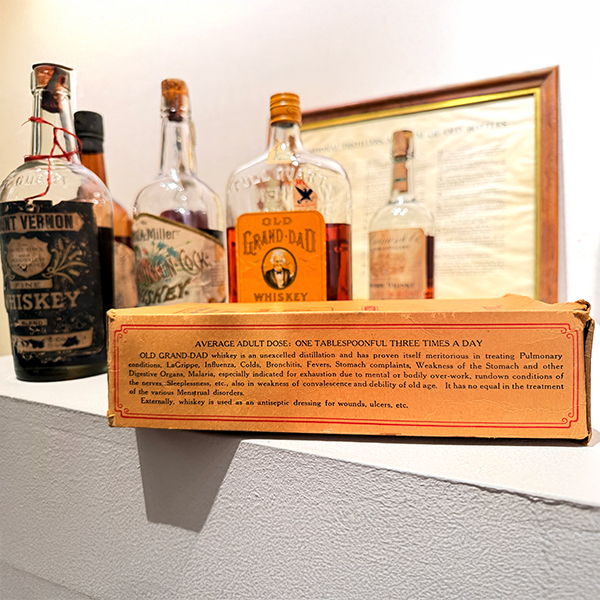
On to the 16 year Old Grand-Dad, distilled in 1916 and bottled in 1932. This bottled in bond bottle features a National Reform Association sticker and a New York State tax stamp. The metal tamperproof cap hides a cork layer that helps preserve the liquid, and this opens up magnificently. Notes of Snickers, orange, caramel, and dusty basement entwine with buttercream, fresh-cut wood, anisette, and lavender. It’s a notable Prohibition pint for a reason. “We have a 1911 quart of this from Bill in gorgeous shape in the sale,” Glesta says. Locate that buyer and beg for a taste.
The Jefferson whiskey, 100 proof, distilled in 1914, bottled in 1919, pours startlingly dark, a deep tawny that looks older than its 5 years. The whiskey is alive: it hisses on opening, and the nose charges out robust and bright: a little rye, rose, bubble gum, banana, and a green edge. “That’s the rush before Prohibition,” Glesta says, “when distillers filled barrels of poorly seasoned green wood as fast as they could to get whiskey into oak.” The palate is full, rich, and lively, lemongrass riding on top.
What 1880 Chicken Cock Tastes Like 146 Years Later
Onto the main course: the 33 year old Chicken Cock distilled in 1880, the year Edison patented the light bulb. The telephone was four years old. Karl Benz wouldn’t build a practical automobile for another five. The oak this Chicken Cock would go into? From a felled tree some 300 years old, germinated from an acorn in the 1500s.
American whiskey aged over 30 years is a novelty—and was in 1913, too—one that yields unpredictable and often less-than-stellar results. Accordingly, this blend of unknown whiskies is rough around the edges. The sludgy liquid resembles prune juice when swirled, coating the glass with thick purple-hued legs from the wood oils. “Or at least we hope it's wood oils,” Glesta jokes. “1913 was late enough to mean this was likely unadulterated.”
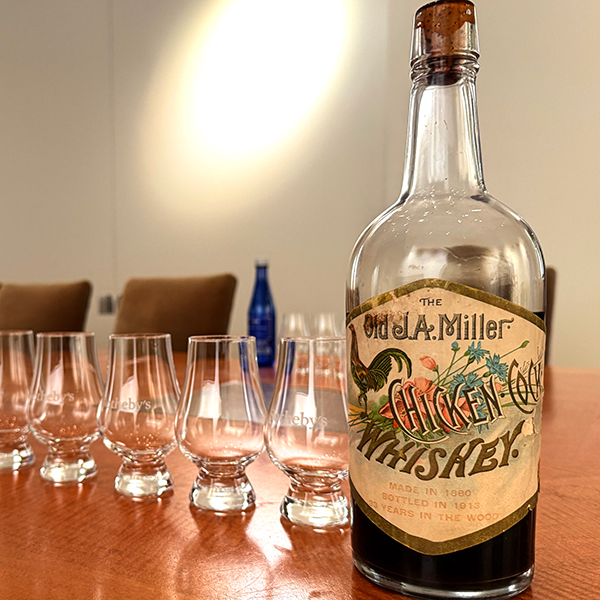
The nose, closed off at first, opens rapidly. “It’s pretty weird,” Carmean says, picking out old tires and molasses. It’s woody, fruity, astringent, and minty all at once. Within minutes, the nose is actually nice. There’s bubble gum, old lipstick, prune, and cherry, too.
Sip to discover none of those aromas are present on the palate. Instead, there’s oak, more oak, and some burnt lumber with added water, as if a rickhouse was aflame and the fire department hosed it all down, then turned that used water into whiskey. Someone mentions it’s like accidentally eating patchouli, and that fits. The finish is… oak, and it only grips harder over time as the 146 year old oils release. Carmean adds water and the dram goes instantly opaque, drawing a chuckle. The earliest produced whiskey I’ve ever tasted landed on snake eyes. Again.
Would it have tasted better in 1914? Probably not. Though Chicken Cock’s producer, Old J.A. Miller, was known for quality, “good whiskey then was very different from good whiskey now,” says Glesta. “I doubt this flavor drifted far from what the profile was back then, but it makes you wonder what it was actually used for,” meaning it could’ve pulled double duty as medicine, a bitter, a tincture, or even a household solvent.
Ruminating on 1880s production methods—of men cutting grains with scythes, hand-hammering casks, moving grains by wagon—gets Carmean wistful. “So much of this was so great, and they didn’t have any of the computers or systems we have now,” he says. “This is as analog as it gets,” Glesta echoes.
A Steal That Turns Into a Gift
Ask if Carmean has any consignor’s remorse, and his eyes dart to the Old Hermitage. “I always knew this would be an amazing bottle," he says. "I wish I'd left it for me and my friends." "This is not your regret meal, Bill,” Glesta jokes. “You spent $365, and you are about to do a lot of good for the world."
That’s because all of Carmean's net sale proceeds are bound for World Central Kitchen. Caring for those in need is a cause that runs close to home for him: Carmean’s mother lived with psychiatric illness, and without his family's support, he says, she would have ended up on the street.
While the six bottles open on the table aren’t among the lots, given the hit rate, the bottles from Carmean’s collection that did make the sale should be superb.
The Sotheby’s Whisky and Whiskey | Featuring The Wax Top Collection Auction runs from September 3rd through the 18th. Check out the lots and register to bid here.