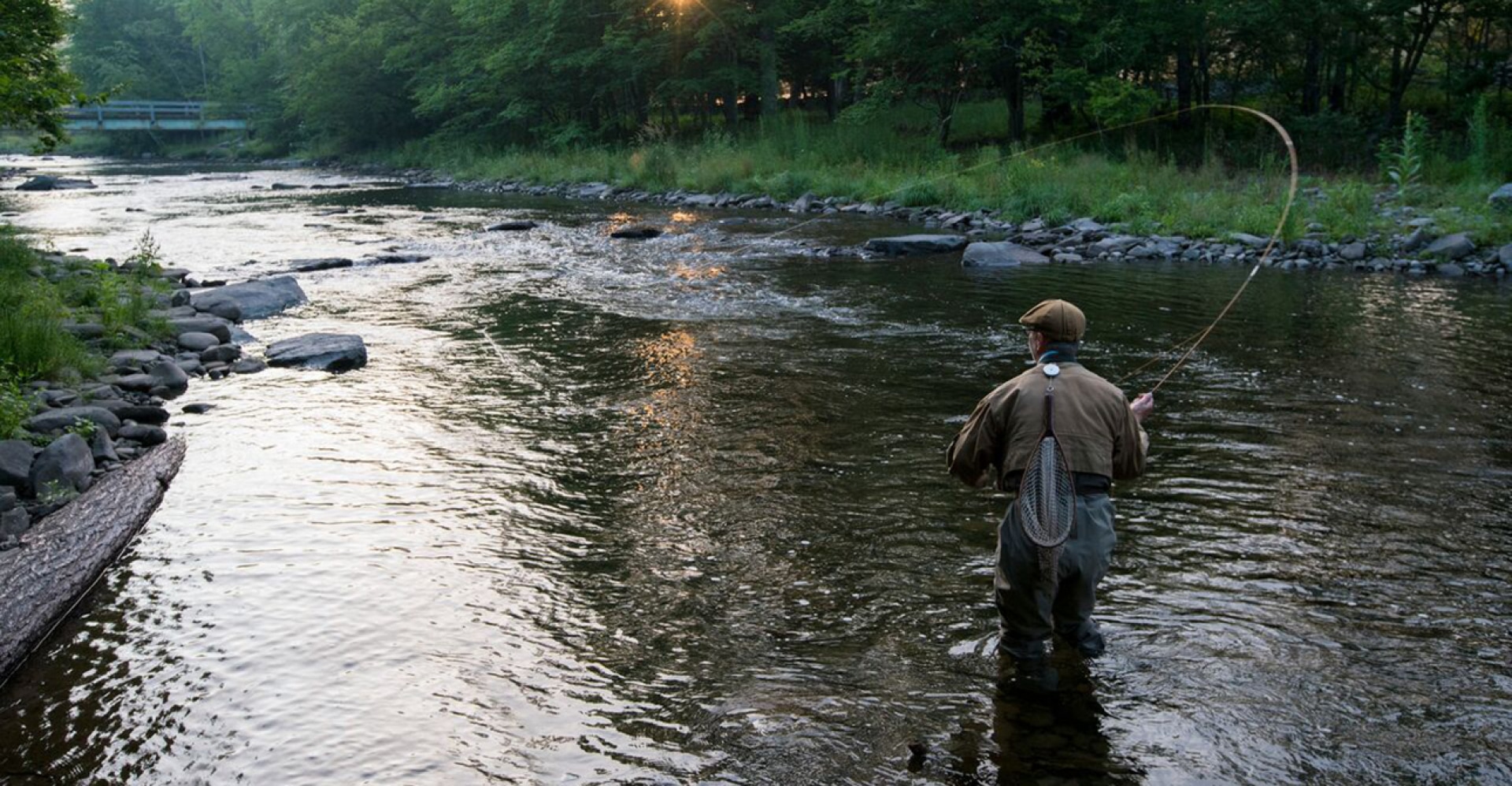
Fly-fishing is just steps away from the front porch of the Beaverkill Valley Inn on the famed Beaverkill River in the Catskills in New York state, in an area known as the birthplace of American dry fly-fishing. CLAY BANKS

Playtime in the Great Outdoors
Fishing, riding, hiking, and more, all tailor-made for whisky lovers
August 26, 2026 –––––– Sean Evans
“Aye, you’ve gon’ and caught the bank,” says Macallan’s head ghillie Richard Whyte. He rushes over, moving fast for a man in a three-piece tweed suit and galoshes, and carefully unhooks the fly and fishing line from the earth beside Scotland’s River Spey, where I had lodged it seconds earlier. Sheepishly, I fling the tip of the 12-foot rod in the general direction of the river, and hear a whoosh as the line flies over my head. The fly lands in the rushing water, though not where I intended. “Better, but watch ye don’ hook yer head,” Whyte says, with a wink. “Happens more than ya’d think.”
Whyte’s thick Scottish accent means even his admonishments and safety warnings sound charming. I’ve fly-fished only once before, in the wilds of Alaska, using a shorter rod and vastly different technique. Whyte runs through a list of reasons why fly-fishing here in the Scottish Highlands is more complicated. The rods are longer, and the casting techniques are an elaborate series of maneuvers designed to keep the fly dancing atop the river’s surface without letting the line itself disturb the surface tension—“Scare ‘em off like that”—and the fish put up prolonged fights after being hooked.
Like his father, Whyte has spent his whole life as a ghillie, the Gaelic term for someone who shepherds you on a fishing or hunting expedition. He’s been head ghillie at Macallan for the past four years, overseeing fishing on the Estate’s property that extends to the banks of the River Spey.
For around £100/$134 a person, anyone can use Macallan’s website to book an afternoon with Whyte and his team—today, relief ghillie Jim Grant and apprentice ghillie Thea Stronach join. A Macallan Estate Bentley Bentayga collected us from our hotel for the excursion, and took us to a quaint wooden hut beside the river. Here, over sandwiches, sausage rolls, tea, and various Scottish delicacies, Whyte explains that the fly-fishing package is actually a deal, considering rods, waders, and lunch are included. (Whisky is not.) Neighboring fishing beats—the term for a privately owned stretch of river where fishing is permitted—charge more and don’t provide gear or meals, he says.

While his black doodle Kobe sprints up and down the riverbank, stick in mouth, Whyte demonstrates proper technique, showing how to wield the rod to cast. The tip of the rod dances in the air, zipping this way and that before the fly touches down. It looks like a masterful execution to me, but Whyte says it could be better and recasts. His second throw of the day sees the line drifting toward shore. “Caught on a rock here, I think,” he says, tugging.
“No, wait. We got a fish, lads!”
Sure enough, thrashing in the water reveals a sizable dorsal fin. “He’s still got fight in ‘im. You want ‘im in quick, but ye don’t wanna rush it,” Whyte says. “C’mon, then! Let’s have ya,” he says to the fish. For 10 minutes, Whyte balances letting the line out and reeling his catch in. Stronach shows up toward the end, net in hand, and scoops the fish. It’s a whopper: 36 inches long and about 16 pounds.
Whyte says it’s an older fish, one that’s made its way to fresh water and back upriver again. Because it’s only catch-and-release on the Spey, after photos, Whyte’s scaly adversary is freed, while Kobe barks in protest.
The rod is then handed to me. The only thing I snag over the next few hours is the bank and river grass. When I quip to Whyte that I’m better at drinking scotch than fishing, he grins. “Well, this is the right place. Drams are in yer future.”
There’s a certain logic to pairing whisky and the outdoors. The landscapes that shape whisky—rivers, barley fields, peat bogs, rolling hills—are also worth exploring on foot, on horseback, or on skis. These five experiences underscore that drams taste better when you’ve earned them.
Fly-Fishing in the Catskills, New York
With a population of about 500, Roscoe is a charming small town about two hours north of Manhattan. This tiny Catskills village is also known as Trout Town USA, due to five legendary trout streams converging within minutes of Roscoe’s Main Street. One of those, the Beaverkill, is to American fly-fishing what the Spey is to Scotland: hallowed water.
Certain eddies and pools are geared toward experienced fishers, while others are well-suited to first-timers. In town, a slew of stores will square you away with all the kit you need, and guides are available to create any kind of day you’d like, from one of casual casting to a pro angler’s nirvana.
Once your cooler is full, head to Do Good Spirits in town, a veteran-owned distillery that operates out of a former firehouse. Authenticity abounds here—the founder is an angler, and the distillery’s Beaverkill straight whiskey is a tribute to the fishing culture that defines the town. Nearby Beaverkill Valley Inn offers private river access for fly-fishing, hiking, winter activities, and a tavern with a selection of local whiskeys.
Visit the Heart of Scotch by Walking the Speyside Way
For those willing to walk, this is the pilgrimage. The Speyside Way is a 70-plus-mile self-guided walking trail through the heart of scotch whisky country, putting you inside the landscape that’s the spiritual home of single malt. You’ll trace along the Spey, the second-longest river in Scotland, passing distilleries including Glenfiddich, Glenlivet, Macallan, and Cardhu, among others.

The full trail takes most people four to six days, threading through river valleys, moorland, and small market towns. (Shorter routes are options, too.) While on the trail, you’ll see everything from ospreys to golden eagles to dolphins. The dolphins congregate to feed on salmon from May to September at the river’s northern terminus, Spey Bay, where it meets the ocean.
Several tour operators offer fully supported packages that book your lodging at various B&Bs, transport your luggage from stop to stop, and help you arrange distillery visits along the way. All you need to do is show up, walk, and drink. Plan accordingly, as in the off-season—November through March—it can be harder to find open accommodations. However, Scotland’s “right to roam” law means that you’re legally allowed to camp on any land that isn’t private property.
Tasting WhistlePig at Spruce Peak, Vermont
Skiers and snowboarders who are whisky fans should check out WhistlePig’s Tasting Shack at Spruce Peak in Stowe, Vermont for apres-ski. Spruce Peak is a proper luxury resort—ski-in, ski-out lodge, spa, geothermal- powered village—where you can spend a morning on the mountain before warming up with a glass or flight of whisky.
The shack, situated in the village center, is a short walk from the lifts. The vibe there is low-key, perfect if you’re tired from a day of runs. The shack lives up to its name; it’s cozy, with seating for up to eight people. Walk-ins are welcome, but reservations are advised for the 30-minute private tasting ($25 per person). There’s a retail corner where you can buy bottles from the full WhistlePig portfolio, including limited releases like Boss Hog, at standard retail prices. Also available are barrel-aged maple syrup and WhistlePig merchandise.
Looking for a bite with your beverage? Try the nearby WhistlePig Pavilion, also mountainside at Spruce Peak. Here, a medley of barbecue dishes, craft beers, cocktails, raclette, and, of course, whisky is on offer. And the fun doesn’t stop when the season’s over. The Stowe area becomes a hotspot for golf, hiking, mountain biking, and more. The Tasting Shack is open year-round, while the Pavilion is seasonal.
Saddle Up For a Ride Into The Grand Tetons
This one operates at a different level, literally. Mason Walker and the team behind luxury experiential group Bourbon Lore will immerse you in the Grand Tetons lifestyle—and whiskey. Your day starts in downtown Jackson, where you create a custom cowboy hat at famed milliner Kemo Sabe, then it’s over to the roughly 300,000-acre Gros Ventre Valley to meet your steed. American mustangs, specifically. Wranglers and Bourbon Lore concierges will lead you on a two-hour horseback ride through the area before arriving at a glamping site.

Here, you’ll be treated to fireside cocktails, a seven-course meal with wine and rare spirit pairings, then a Wyoming Whiskey tasting flight of limited releases. Its craft whiskey utilizes locally grown grains and matures in the same high-altitude air you’re breathing. Post-meal, Bourbon Lore has one more treat: an acoustic country music performance under the stars. Custom-rolled cigars are available, as are additional whiskies. Luxury comes at a price; here it’s $35,000 and up for six people.