
Never Mix Grape and Grain? Starward Didn't Get the Memo
The Australian distiller’s Project Co-Ferment has created a hybrid expression made from grape juice and malted barley
July 2, 2026 –––––– Jonny McCormick
For generations, drinkers have been warned “grape or grain, but never the twain,” but now an ambitious distillery experiment in Australia has challenged that convention, giving rise to an entirely new spirit category in the process. Project Co-Ferment was the brainchild of Carlie Dyer, head distiller and head blender at Starward Distillery in Melbourne. After seven years in the wine industry and obsessed with the process of flavor creation, Dyer crossed from grape to grain, joining Starward in 2018. Inspired by its experimental outlook and its dedication to maturation in Australian red wine casks, she wondered how wine and whisky could come together, not just during maturation, but from the very beginning. That curiosity resulted in the creation of a spirit from grape juice and malted barley.
Dyer began with equal parts of freshly pressed cabernet sauvignon juice and malted barley wort. She pitched distiller’s yeast and a Belgian ale-style brewer’s yeast, then left it to ferment for 34 hours before double-distilling the wash in a five-liter experimental still. Dyer recalls something magical happening: the room began to fill with wonderful aromas of strawberries and cream, telling her she was on to something good. As a new make spirit, it had an almost brandy or eau de vie-like character, though with plenty of body and depth from the malt. The successful trial was later scaled up to full production, first with cabernet sauvignon, then with shiraz grapes.
Co-Ferment honors Starward’s view that raw materials—malt, grapes, and casks—come from within a day’s drive of the distillery. Half the spirit was filled into French oak red wine barriques, wet-filled from the winery, while the other half was filled into charred American oak red wine casks. Starward’s standard filling strength is 55%, as its maturation conditions push the ABV up by 0.5%–1% per year. Melbourne experiences significant seasonal temperature variations, so the heat can really build up inside the distillery’s uninsulated bond houses during the summer. Depending on barrel size, their angels’ share losses can be as high as 5%–10% per year.
Co-fermentation may feel radical, but the practice has a surprisingly long history. In 12th-century Russia, grain and honey were fermented together, while German distillers produced a spirit called Troster in the early 18th century by fermenting grape pomace with ground barley or rye before distillation. Troster was shipped to the Netherlands, where it underwent further distillation to be sold as gin. Starward's version, however, takes the concept in a different direction, aging the spirit for 6 years in oak casks like whisky or cognac, longer than most Starward whisky expressions. Today, co-fermentation is a major trend in specialty coffee, making Project Co-Ferment just the latest chapter in a centuries-long pursuit of new flavors.
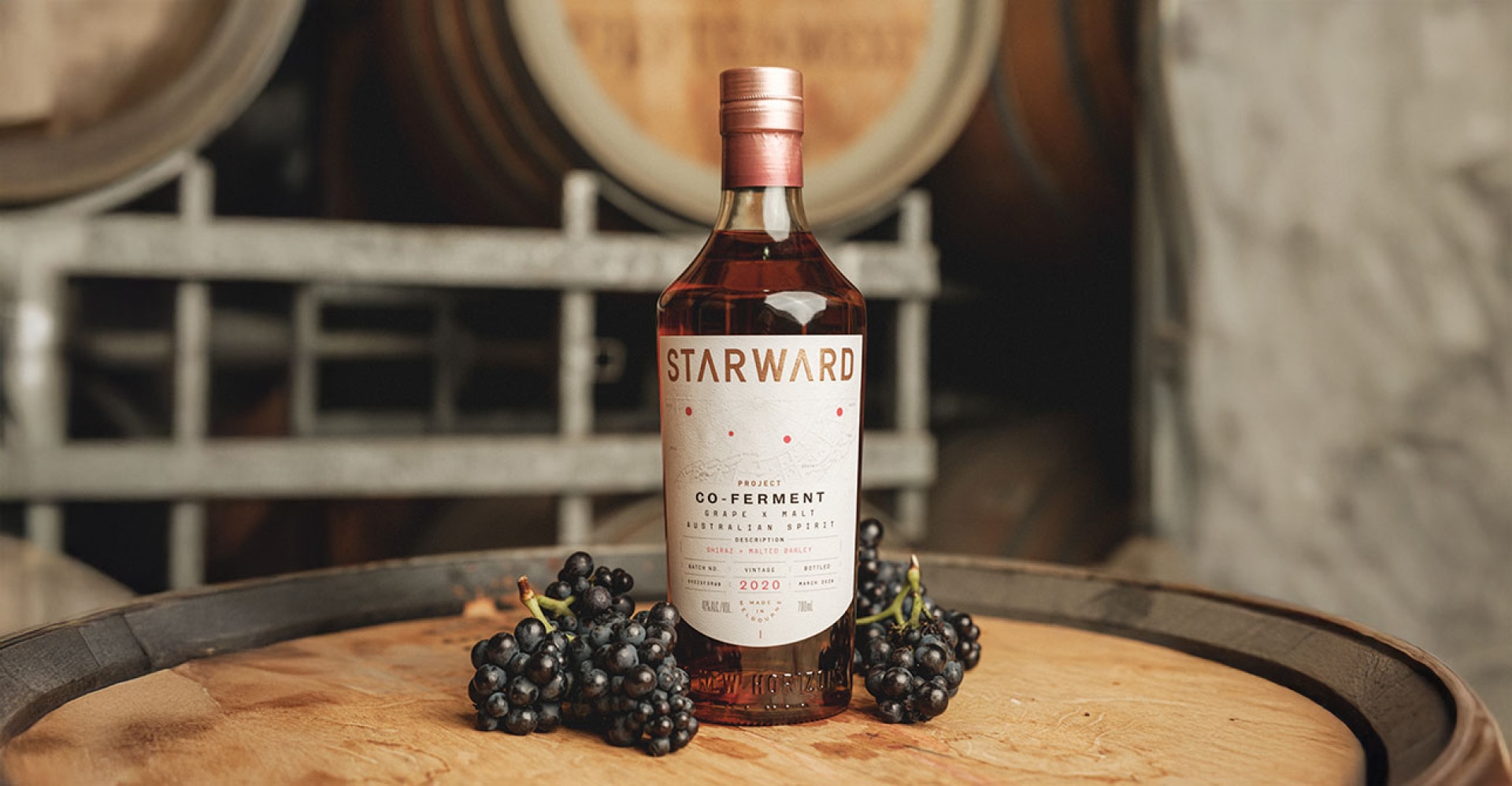
Starward Co-Ferment expressions are fruit-forward spirits with flavor profiles specific to each grape variety. Red wine-finished single malts can approximate some of the flavors, though not the luxuriously rich mouthfeel and finish that make them distinctive tasting experiences. Bottled at 46% ABV, the Cabernet expression shows black fruit, cinnamon, vanilla, and toasted oak flavors. The Shiraz release is bottled at 41% and offers red berries, coconut, baking spice, and a creamy finish. Dyer found the viscosity on the Shiraz release opened up at ABVs below 46%, so selected a lower ABV than the Cabernet release to showcase the best tasting experience.
Labeled as Grape x Malt Australian Spirit, Starward Co-Ferment is currently available in Australia only, as it’s difficult to export orphan spirit drinks without a recognized category. Neither whisky nor wine, it bridges the worlds of grain and grape while retaining a distinct identity. Dyer believes this hybrid concept has global potential. If producers in regions of the U.S. known for both wine and whisky adopt co-fermentation, it could build momentum and pave the way for grape and grain spirits to become a recognized category in their own right.