
Brother Justus on Making Minnesota Single Malt
Owner Phil Steger's journey from whiskey enthusiast to distiller, with a resumé so far that includes several 90+ whiskeys
February 20, 2026 –––––– Laura Pelner
Minnesota native Phil Steger had been a longtime whiskey lover, but the idea of actually making whiskey himself was never part of the plan. That is, until he visited a distillery in Kentucky and started formulating an idea for a “better American whiskey.” But even then, he spent years working on whiskey chemistry while also working as a lawyer and an activist before moving full-time to distilling and taking the plunge to found Minneapolis-based Brother Justus Whiskey Co. in 2014.
A law school graduate, Steger’s eclectic career included work as an attorney and humanitarian, as well as years spent helping monks to digitally preserve centuries-old manuscripts. It was during that time that he came to appreciate the importance of protecting cultures. And it was also during his time preserving manuscripts that this whiskey-lover had a life-changing moment: After visiting James B. Beam Distillery in Clermont, Kentucky to take a tour in 2007, his dream to produce his own whiskey began to take shape. “I was a huge fan of Knob Creek,” he says. “It was barrel-forward, oak-forward—it was America in a glass. Right there on the tour, I had a vision of making an even better American whiskey.”
The choice of American single malt was strategic, as Steger didn’t want to go up against a highly crowded bourbon market. “The [bourbon] industry is so competitive, and there’s so much good liquid,” he says. “I had to do something fresh.” In its earliest days in 2014 and 2015, Brother Justus was basically in experimental mode. “I knew the flavors I wanted,” Steger says. “We figured out how to distill so we could isolate those flavors.”
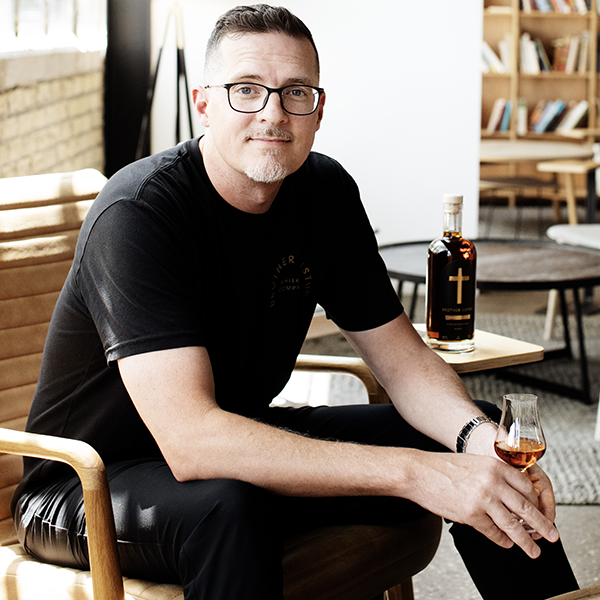
Steger began studying whiskey chemistry in 2008, soon after visiting Beam, and he applied for his first permits to make whiskey in 2014, with real research and development on whiskey recipes and distilling beginning in 2015, even though Steger was still working as a lawyer at that time. He brought whiskey maker James Jefferson on board in 2015, and the two began working out of a small distillery in a warehouse space with a 26-gallon still and 5-gallon barrels for aging. They went through hundreds of fermentations and a thousand barrels over many years before settling on the final flavor profile for Brother Justus.
Eventually they outgrew their initial space and opened a commercial distillery in 2021, during the height of the Covid-19 pandemic. The first Brother Justus Whiskey Co. products hit shelves in Minneapolis in 2021 and were widely available in Minnesota in 2022. Today, the distillery has a production capacity of roughly 24,000 9-liter cases a year, though the company makes a fraction of that amount, as the whiskeys are not nationally distributed. Steger notes that he’s capable of scaling for further growth should the need arise. The company’s aging whiskey inventory is at about 29,000 9-liter cases.
The Brother Justus name is a nod to an interesting chapter in Minnesota history about a man named William Trettel, a Benedictine monk at St. John’s Abbey in Minnesota, about 75 miles north of Minneapolis, who took the monastic name of Brother Justus. As grain prices plunged during the Prohibition years, Justus saw local farmers struggling to feed their families and hold onto their farms. A skilled blacksmith, he showed them how to make copper stills and use Benedictine distilling techniques to make whiskey, which allowed them to convert their crop into cash. The result? Many high-quality whiskeys were produced by Minnesota farmers, helping the state earn a reputation for quality moonshine during Prohibition.
The Core Expressions
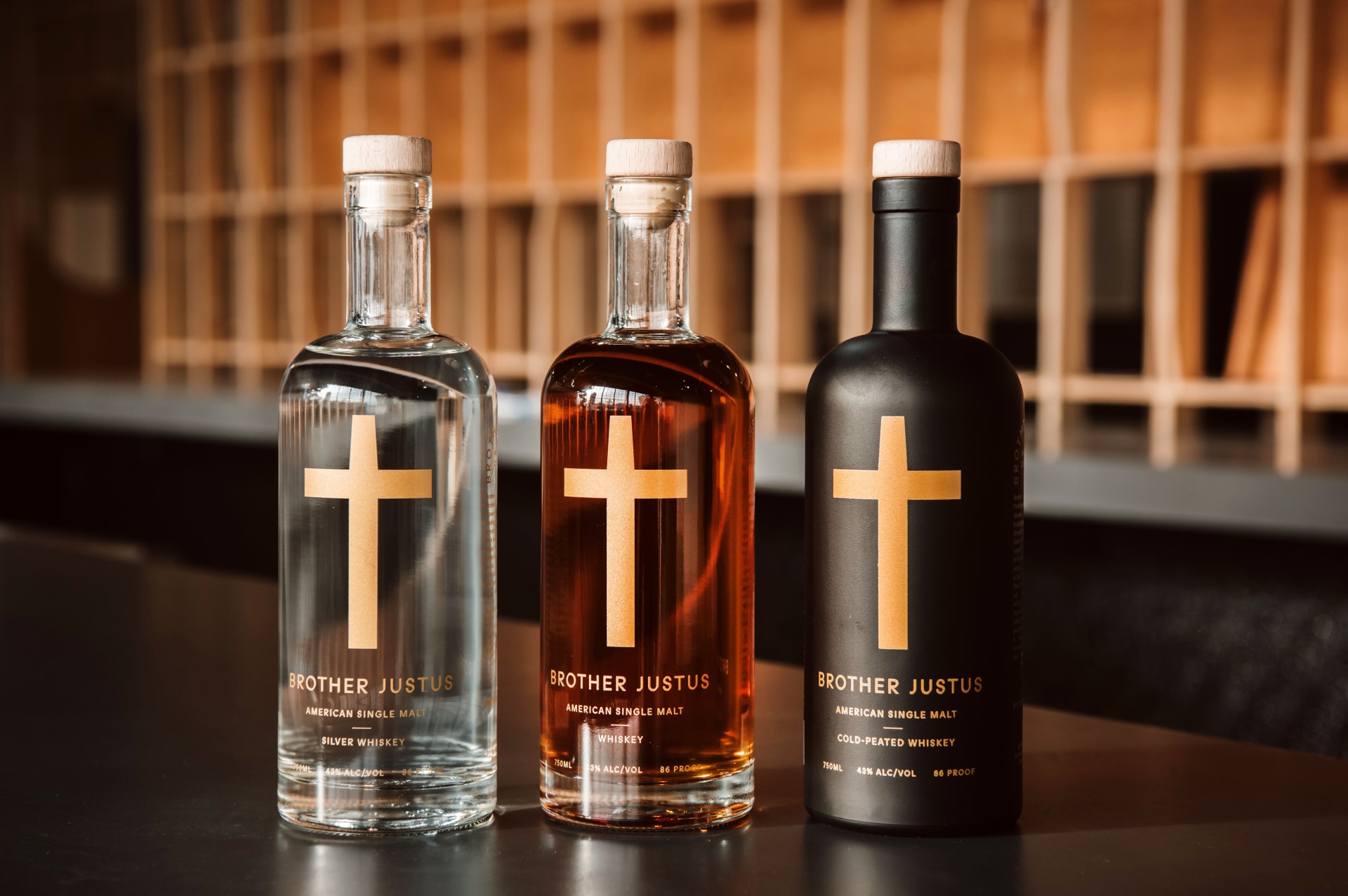
The Brother Justus Whiskey Co. makes three core expressions, all with 100% malted barley and fermented, distilled, and barreled in-house. The spirits are made on a pot still, with a column attached during distillation. The American single malt (43% ABV, $70), the flagship, is made with barley grown in the nearby Great Plains and malted 20 miles from the distillery, as well as Minnesota limestone-fed water, and aged in barrels made of locally grown and coopered white oak.
Also in the portfolio is Cold-Peated American single malt (43% ABV, $100), which gets its peat character not by burning peat to smoke the malt, but by using locally grown peat as a filtering agent. Steger likens it to Tennessee whiskey’s Lincoln County Process, and he hopes to have his method officially designated as the Aitkin County Process, for which he’s already filed patent applications. “We call it the Aitkin County Process, which is where our peat comes from,” Steger says. “It gives us control with filtration, and the result is incredible.” The brand’s third core label is Silver (43% ABV, $50), a minimally aged American single malt that’s intended for cocktails. Brother Justus is available at retail in Minnesota and Illinois, and online for shipping to 40 states.
Beyond its core offerings, the company has Founder’s Reserve, a limited annual release. So far, there have been three editions—2023, 2024, and 2025 (ranging from 58.5-62.5% ABV, $130 each). Steger says he plans to release one each year for the foreseeable future. “Founder’s Reserve is really good whiskey that’s different from our existing offerings,” Steger explains. “We blend them until we get a complete expression for that year. Every year is unique.”
For all its whiskeys, Brother Justus seeks to use locally sourced ingredients. “Minnesota has the land and the history for whiskey,” says Steger. “This is the ecological and geographical center of North America, and a state that has every ingredient you need to make malt whiskey.”
Brother Justus also produces a lineup of liqueurs, ranging from cinnamon to honey to orange to an aperitivo. They’re not sold commercially, but are used in the distillery’s cocktail room. Steger says he’s continuing to develop his private barrel program for retail stores too, currently focusing on Minnesota retailers, though he hopes to make barrels available to Chicago stores soon.
The Brother Justus Lineup
92 points - Brother Justus Founder’s Reserve 3 (2025 Edition), 62.5%, $130
Dried lemon, tiramisu, cinnamon baked apples
91 Points - Brother Justus Founder's Reserve 1 (2023 Edition), 58.5%, $130
Cherries, tropical fruits, dusty earth
90 points - Brother Justus, 43%, $70
Lime zest, lemonade, minerality, stone fruits
89 points - Brother Justus Cold Peated, 43%, $100
Peat, lemon, grapefruit, apple cider
NR - Silver, 43%, $50
Recommended for cocktails