
Exploring Hungarian Oak
While more commonly used in winemaking, some whisky makers are turning to the oak for richer flavor
January 9, 2026 –––––– Julia Higgins
Whisky makers have been pushing the boundaries of innovation, and those efforts have included the exploration of various types of oak for maturation. While producers around the world rely on American oak and some European oak varietals—French and Spanish chief among them—other oak species, like Japan’s mizunara, have also come to the fore. Newer still is Hungarian oak (not to be confused with Hungary’s tokaji wine cask finishes), which has only been used for whisky since the 2010s.
Unlike its more porous American oak counterparts, Hungarian oak has a tighter grain, which means the whisky and wood interact more slowly. This enables longer maturation times and subtler flavor impact. Among the earliest adopters of Hungarian oak were Masterson's Rye, which debuted a 10 year old Canadian rye finished in Hungarian oak back in 2017, and Irish Distillers, with its Method & Madness expression from 2018—a single malt aged in bourbon barrels and finished in Hungarian oak that was not released in the U.S. Since then, others have dabbled in Hungarian oak maturation as well.
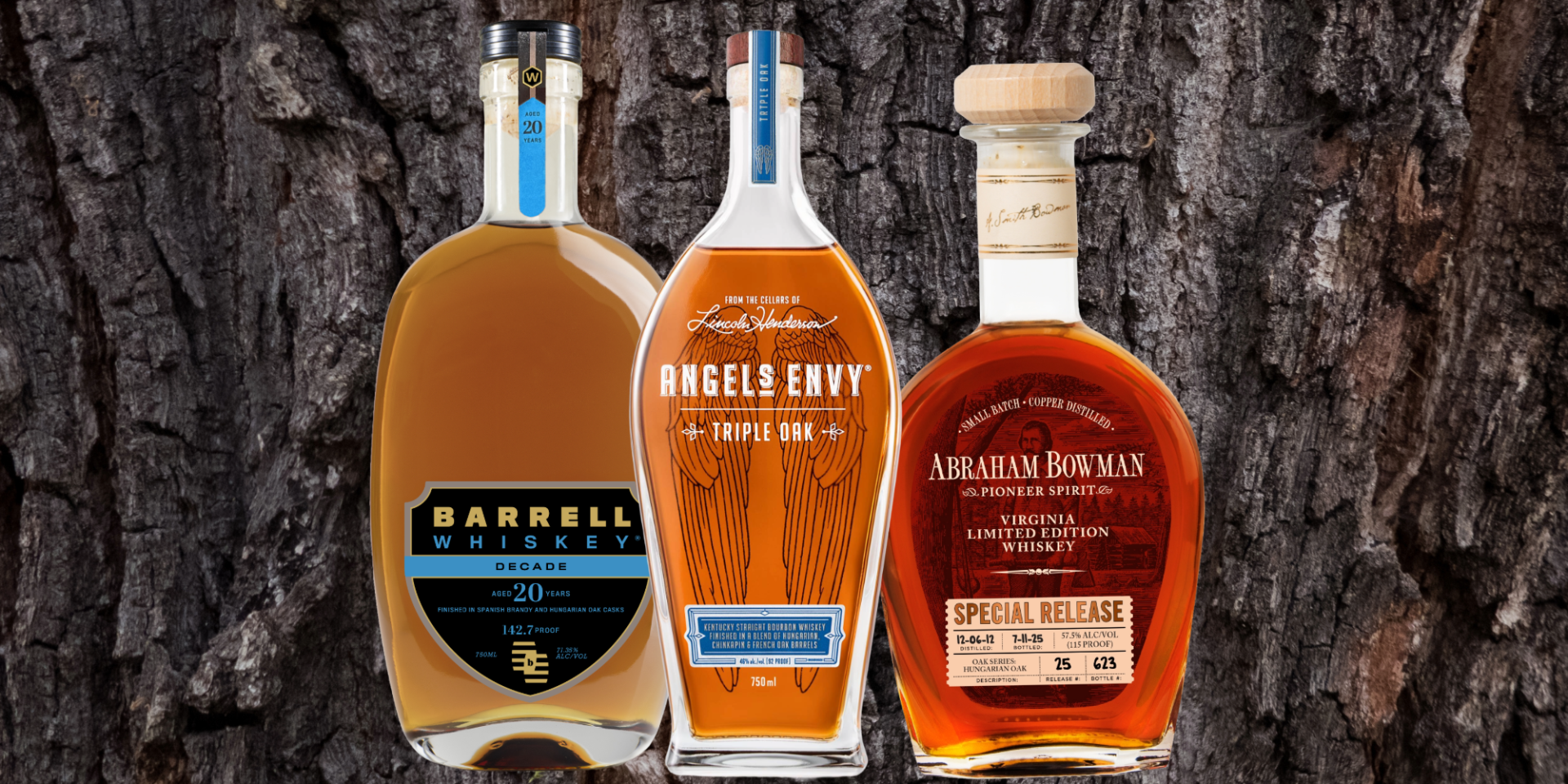
Among the more recent endorsers was Angel’s Envy, which introduced its Triple Oak—a bourbon finished in a combination of Hungarian, chinkapin, and French oak barrels—in September 2024. For the first batch of Triple Oak, master distiller Owen Martin turned to second-fill Hungarian oak barrels, finishing the whiskey in them for 6 months. In his early experiments, Martin quickly took stock of its characteristics. “There’s this thing I try to target as a blender; I just call it ‘juicy,’ but it’s that quality that makes you sip, and makes you salivate,” he says. “It’s something I’m always looking for in my blends, and I think of the three components [in Triple Oak], the Hungarian oak is that. Those barrels have a super bright, fruity profile, they’re mouthwatering, and they’re also sweeter, with some caramelized vanilla in the mix.”
While Martin used second-fill barrels, others have used virgin Hungarian oak. In the spring of 2023, GlenAllachie introduced the third batch of its Virgin Oak series, which included three limited edition single malts—one of them a 7 year old that underwent an 18-month secondary maturation in toasted and charred virgin Hungarian oak. More recently, Virginia’s A. Smith Bowman Distillery debuted the third and final release in its Oak Series: Hungarian Oak. The 12 year old bourbon was aged entirely in charred Hungarian oak, and was available exclusively via an online lottery that took place in August 2025. Head distiller David Bock noted that the whiskey was among the most well-rounded he’d ever tasted, and carried a rich, glossy profile—adjectives similar to those used by GlenAllachie, which called out silky richness in its Hungarian oak-finished single malt.
Aside from Angel’s Envy’s permanently available Triple Oak, the vast majority of whiskies matured in Hungarian oak remain smaller in scale and harder to find than those aged in other exotic wood counterparts like mizunara. That said, as more whisky makers shine a spotlight on the wood and its favorable characteristics, there’s a good chance we’ll see more of it throughout this new year and beyond—and if you see a bottle on the shelf, consider giving it a try, especially if you’re after fruit-forward flavors that deliver mouthwatering results.
A Selection of Whiskies Matured in Hungarian Oak
94 points - Abraham Bowman Special Release Oak Series: Hungarian Oak Bourbon, 57.5%, $80
This bourbon was aged entirely in charred Hungarian oak
90 points - Angel’s Envy Triple Oak Straight Bourbon 46%, $75
Finished for 6 months in second-fill Hungarian oak (in addition to chinkapin and French oak)
88 points - Bearface Triple Oak Single Grain Canadian, 42.5%, $40
Finished in a combination of air-dried virgin Hungarian oak and French red wine casks
Bardstown Discovery Series No. 13 Blend of Straight Bourbons, 55.4%, $140
About 39% of this blend of bourbons was finished in Hungarian oak for 4 months
Barrell Decade Blend of Canadian Whiskies, 71.35%, $199
Comprised of components distilled each year from 1995 to 2005, the final blend underwent secondary maturation in a combination of Spanish brandy and Hungarian oak casks