
Old Forester's Latest 117 Bourbon Is Inspired by Prohibition-Era Methods
Bottled at 130 proof, it mirrors the distillery’s Prohibition-era still strength
December 9, 2025 –––––– Danny Brandon
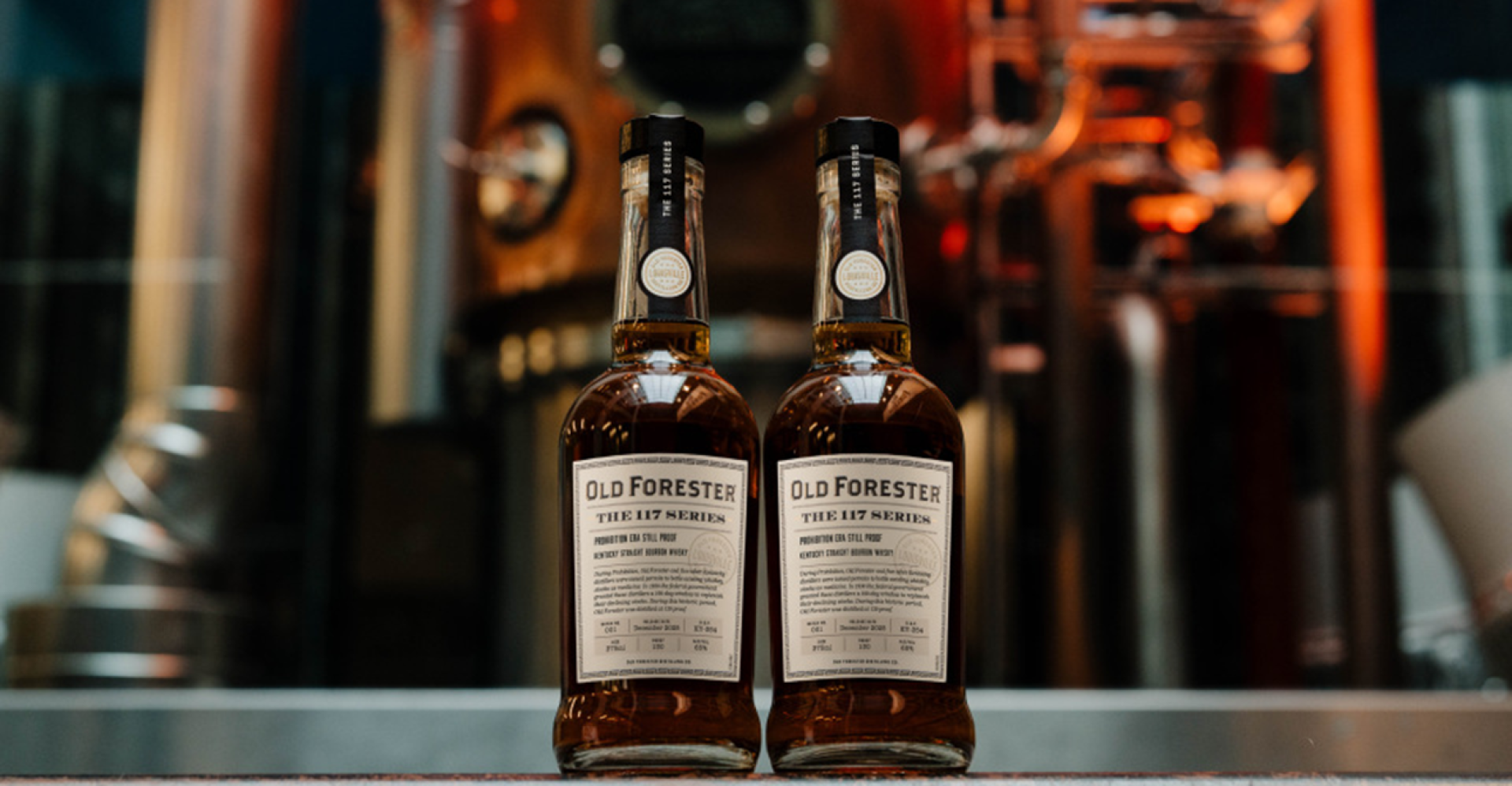
Last Friday marked the 92nd anniversary of the repeal of the Volstead Act, an event that effectively ended Prohibition in the U.S. Nearly a century later, December 5th has become an informal holiday in the whiskey world, with whiskey lovers and makers raising a glass on Repeal Day. For some distillers, the occasion is also a good opportunity to release new Prohibition-themed whiskeys, with a notable example being the annual Remus Repeal Reserve bourbon from Ross & Squibb. This year, Old Forester has commemorated the holiday with Prohibition Era Still Proof, a high-proof 117 Series bourbon inspired by whiskeys the distillery produced a century ago.
High-Proof Homage
Like Old Forester’s other bourbons, Prohibition Era Still Proof starts off with the distillery’s trademark mashbill of 72% corn, 18% rye, and 10% malted barley, distilled at 140 proof. It was barreled at 125 proof and aged just shy of 5 years before bottling at 130 proof.
That high proof point is a callback to Old Forester’s production method during the 1920s. When Prohibition took effect in July 1920, it forced distillers across the country to close. But Old Forester was one of the few distillers that held a license to produce “medicinal whiskey” that could be purchased with a doctor’s prescription. The switch to medicinal whiskey required Old Forester to temporarily adjust its house style, lowering both distillation proof (130 vs. 140) and entry proof (100 vs. 125) to produce 50% ABV whiskey with a consistent flavor profile. The distillery eventually went back to using 140 and 125, respectively—it still uses those points. But this whiskey’s proof pays homage to the brief period in its history when it used a still strength of 130.
This isn’t the first time the distillery has invoked aspects of its 1920s-era production method. Old Forester 1920 Prohibition Style, which belongs to the history-focused Whiskey Row collection, was created on the same premise as the newcomer: leveraging proof to give drinkers an idea of what its Prohibition-era house style tasted like. That whiskey is bottled at 115 proof, which, according to Old Forester, would’ve been the typical strength after aging its Prohibition-era barrels. During that time, its barrels were filled at 100 proof and would’ve seen a sharp increase in strength during maturation, thus requiring it be proofed back down to 50% ABV before it could be bottled for use as medicinal whiskey.
Old Forester 117 Series: Prohibition Era Still Proof Bourbon
ABV: 65%
SRP: $65/375 ml
Availability: At the distillery, select Kentucky retailers, and online