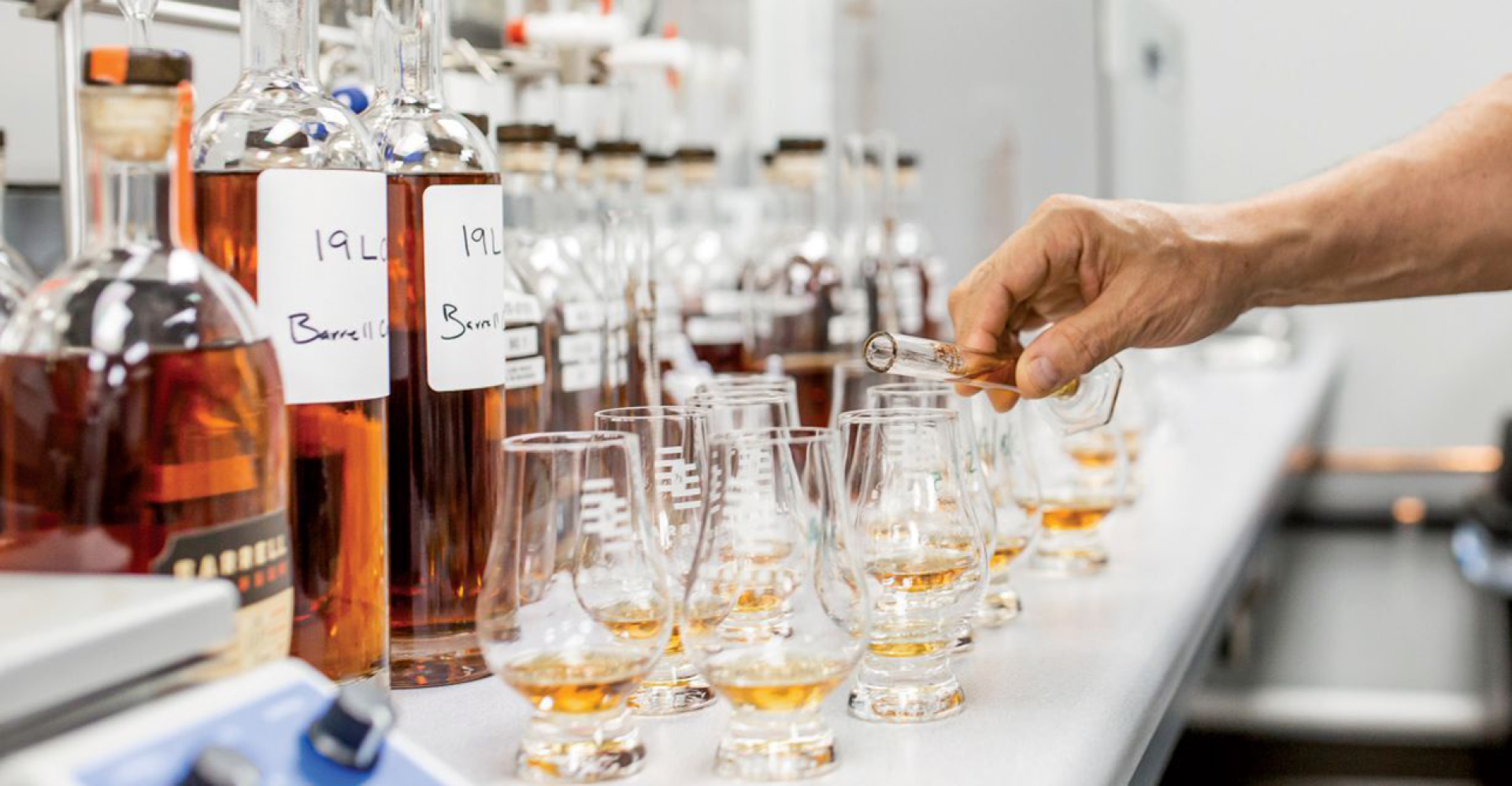
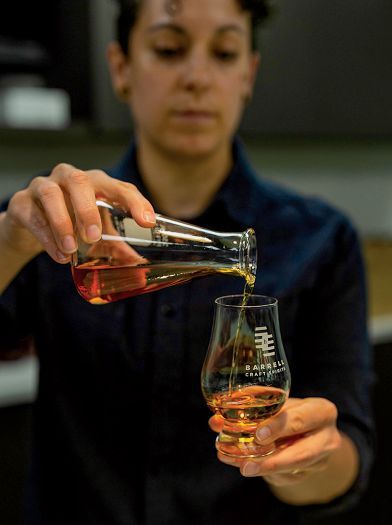
Barrell Craft Spirits has hundreds of experimental barrels in inventory, with a variety of finishes aimed for blends or micro-batches.

Microblends: Whiskey's Hottest Trend
Barrels are being blended in small batches to create some truly unique whiskeys
January 23, 2026 –––––– Sean Evans
Single barrel whiskeys, pulled from a single cask chosen by an individual or a group, are all the rage. They’re usually selected for representing the apex of a whiskey’s flavor profile, or sometimes for being very different, and each single barrel is unique. But what if you wanted to create a whiskey that’s even more bespoke? The answer lies in micro-blending, the latest wave in the private barrel whiskey world.
Micro-blending is the practice of blending all or part of two or three single barrels, sometimes all made from the same mashbill, but increasingly from different mashbills and finishes. “The market needs more innovative and dynamic flavors, pushing the boundaries of what whiskey can be,” says Dark Arts Whiskey House founder Macaulay Minton. “Micro-blending is the ideal progression.”
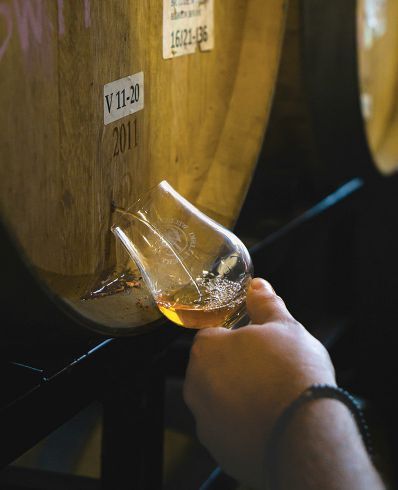
Minton’s micro-batching journey began after a field trip to Kentucky’s Wilderness Trail Distillery in 2016, while in college, where he was studying brewing and distillation. He ended up working at Wilderness right after graduation, first in yeast operations, then as a distillery operator. By happenstance, from behind the gift shop register, Minton sold 100 single barrels, which led to the development of a single barrel program that would grow to more than 1,000 barrels annually. Upon Wilderness’s sale to Campari in 2022, Minton left the company and wanted his next project to provide the stakeholder with a larger role in crafting private whiskey. Around this principle, Dark Arts was born.
Trial and Error
At the Dark Arts workshop in Lexington, Kentucky, private barrel clients can select a single barrel from any of his stocks, all of which are 7-plus year old MGP distillate. They’re made from one of three standard mashbills: two bourbons, 51% corn, 39% rye, and 10% malted rye, and 60% corn, 36% rye, and 4% barley; and a 95/5% rye. All are aged in Indiana, while finishing takes place at Minton’s facility in a variety of different woods, including spirits and wine barrels from far-flung global locations. From this array of options, Minton works with clients, pulling liquid from multiple barrels to create a bespoke blend.
At the client’s disposal is an extensive lineup of finishing barrels. “We have a lot of French oak, mizunara oak, sakura wood, Brazilian amburana, some African wood, and plenty of American oak,” Minton says. Some of this is virgin wood that’s custom-toasted, then those staves are inserted into the original 53-gallon cask that the whiskey was matured in. Previously used casks include many wine barrel options like red port, white port, pinot noir, oloroso, PX sherry, armagnac, calvados, sauternes, and Spanish orange wine. “Basically whatever I can find that’s interesting and high quality, I bring it in,” Minton says.
To shake out the right flavor profiles, Minton does home maturation experiments with mason jars, gallon jars, and fermentation vessels into which he adds different types of wood samples with various finish and toast profiles. “There are many prototype duds, but when one hits, it’s great,” he adds. Those winners graduate to become full barrel fills within his warehouse, as options from which a client can blend.
The custom micro-blends don’t require the client to buy all of the component barrels to arrive at one 53-gallon blend. “I charge only for what the client needs, and find another use for any excess,” Minton explains. This method allows for increased flavor profile leeway, and keeps the per-bottle suggested retail price at around $100, vital for retailers introducing untested expressions. One early Dark Arts customer is retailer Ryan Maloney, owner of Julio’s Liquors in Westborough, Massachusetts.
Maloney, who buys an average of 100 single barrels annually across multiple spirits categories for his Loch & K(e)y brand, says, “We don’t take what’s offered, we take what’s good. With Dark Arts, you’re now creating what’s good, a more difficult skill [than picking a standard single barrel]. Plus, I can regularly mess with finishes and custom blends.” Maloney was among Minton’s first customers, creating two Dark Arts expressions.
“Macaulay was climbing over barrels in his rickhouse to yank samples for us,” Maloney laughs, adding he loves each resulting 7 year old expression, the final ratios being blended over the course of hours. The first is Portal, a 111.36-proof melding of rye barrels finished in white and red port barrels. “There aren’t many white port-finished ryes,” says Maloney, “and we loved the first few barrels we tried.” The second creation, Arm and Oak, is a 117.36-proof straight bourbon finished in both armagnac casks and with French oak staves, then blended together. Both bottles are pleasing divergences from flavor profiles associated with the base MGP distillate.
Micro-Blending Pioneer
Credit for the micro-blending moniker may belong to Marci Palatella, who ran a distribution company in the ’80s and ’90s, pushing America’s unwanted bourbon to European and Asian markets. “I had a brand called Dakota Micro Batch,” Palatella recalls, adding that she’s always been a fan of the practice. “I found there were elements missing in some single casks—desired profiles that could be enhanced by small amounts from one or two additional barrels…and not in equal parts.”
Back then, Palatella’s micro-blending was driven by fiscal constraints—“I didn’t have the funds to purchase large quantities of anything”—but the output, including brands like Very Olde St. Nick, Preservation, Rare Perfection, Wattie Boone, and more, was wildly popular. “Our first fans commented that nothing we released tasted the same, although they wanted more,” she says. Consistency was never the goal, instead she preferred each release shine as a stand-alone.
Now, Palatella owns Preservation Distillery + Farm in Bardstown, where the entire operation is themed around micro-batch production. A single micro-batch of a unique mashbill is milled and cooked, using the farm’s limestone water, then moved to a single fermenter and ultimately, run as a single pot distillation, yielding one to three barrels. “It’s labor intensive,” Palatella says, “but the results are worth it.”
Blender’s Spice Rack
Taking products available on the bulk market and leveraging them for their individual flavors in the blending process is Louisville’s Barrell Craft Spirits’ great skill. “We don’t want to cover up those characteristics,” says chief of distillery operations and chief whiskey scientist Tripp Stimson.
“We want to highlight those.” Sourcing from 65 suppliers worldwide, including craft distillers running unorthodox systems, and tasting everything from new make up to 20 year old liquid, Barrell has hundreds of one-barrel experiments running at any given time. “We have between 50 and 100 unique products within our private release program each fall,” he adds. If successful, those barrels become components in larger blends, or are released as part of a micro-batch private release program. “Smaller finishing volumes allow greater concentrated flavor from finishing casks,” Stimson notes, adding the casks are, in effect, like spices in the spice cabinet. Lately, the popular cask “spices” have been ice wines, like tokaji from Hungary, or Ratafia fortified wines from Mediterranean regions.
Balancing Act
Not every micro-blend works out. “The flavors that you may have attributed to two exceptional barrels on an individual basis may not complement each other when married,” says Kyle Lloyd, Preservation’s general manager and master of maturation. The aim, according to Lloyd—a chemical engineer who spent a decade at Michter’s focusing on innovation strategy—is to balance and accentuate individual flavors. “Otherwise, when barrels are in conflict, you have a whiskey that is struggling to decide what it wants to be.”
Lloyd has plenty of options for micro-blend marriages; Preservation has several thousand barrels of distillate maturing, along with ample aged stock contract distilled by legacy distilleries from years ago. “If needed, I could pull Kentucky bourbon that’s over 20 years old,” says Lloyd. After finding two or three suitable barrels, Lloyd and his team pull samples, blend those in a ratio based on the weight of the liquid in each barrel, and revisit this sample often. “We’re seeing how the liquid changes over time,” he says. “Are we still enthusiastic about this product? Sometimes, down the road, the flavor moves in a less desirable direction.”
One new success is a 100% house-distilled bourbon. “It’s called Preservation Pot Distilled bourbon,” Lloyd says, adding the team is “trying to make combinations of two to three barrels to build a pipeline of batches for future releases.” Each of those lots will be less than 500 bottles, bottled at cask strength and released in batches. While that method is less efficient, “We’re giving that whiskey every day it can have in a barrel,” says Lloyd.
Micro-batching Distillers
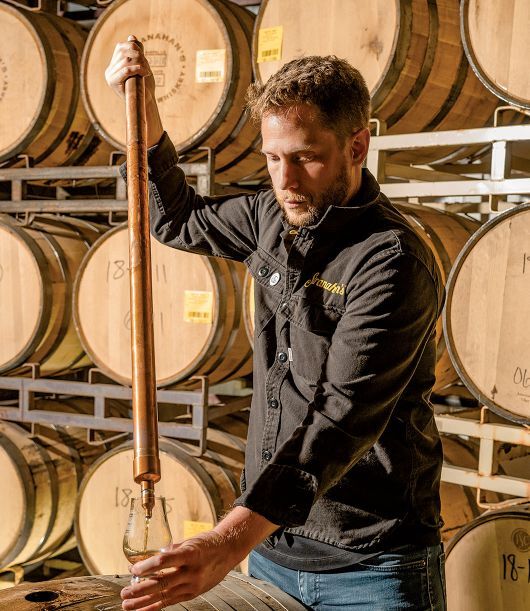
Justin Aden, head blender at Stranahan’s Colorado Whiskey, is thrilled that micro-batching is finally getting its due. “For so long, blends were viewed as inferior,” Aden says. “Now, because we have so much interest in whiskey [and consumers have become more educated] over the last decade, it’s gaining steam.” Aden’s fundamental approach is that any blend should be of a quantity that allows you to still identify each individual barrel’s contribution.
Right after Aden was hired in 2023, he began work on Stranahan’s distillery-only annual release, Snowflake. “I dove into our finishing barrels in the warehouses, getting into calvados barrels. I loved those so much, I didn’t want them to get lost in the Snowflake blend, which has (whiskey finished in) mezcal and Islay scotch barrels,” he says. That organic discovery is the beauty of the micro-batch. “You weren’t setting out to make it, but you taste it, and it tugs at your heartstrings.”
For one micro-batch, Aden yanked six calvados finishing barrels and tried adding a seventh, “but I was losing the beauty from the younger calvados barrels,” he says. “It’s important to know when to stop the blend size to do it justice.” The resulting six-barrel blend, Stranahan’s Calvados Cask Finish, is currently for sale at Stranahan’s Whiskey Lodge in Aspen.
Another distillery-only exclusive is a 375- ml experimental bottling resulting from loaning barrels to local producers. “Some went to a natural honey producer and some went to a tea house for aging black tea,” says Aden. “They come back, they’re quirky, and I don’t know what to do. I filled them with whiskey and waited a month. Those potent flavors started to go together, so I pulled in a 10 year old whiskey to give body to it, and those three barrels became Honey In Your Tea American single malt. I would’ve otherwise written them off.” (After we tried a sample, we’re glad Aden stayed the course.)
Future Of Micro-Batching
What can you expect to see in the future for micro-batching? With inventories rising in the whiskey business, it seems likely there will be plenty more liquid available for micro-blenders to purchase if they wish, and specifically more aged liquid.
For his part, Minton says his offerings are rising in age statement. One recent straight bourbon selection by luxury sample bottle creator Liquid Ministry boasts a 10.5-year age statement and a further pushing of flavor boundaries. “We [Julio’s] did a project with Old Elk,” says Maloney. “It’s a four-grain straight whiskey, and it is a vintage 13 year old bourbon mixed with 8-year Old Elk high-rye bourbon, then married in an armagnac cask. There’s a portion of wheat whiskey aged in sauternes casks, another wheat whiskey finished in port casks, and an 8 year old rye. It’s well-balanced, but it falls into no specific category because of the way we mixed it.”
If you do your whiskey right, Aden muses, no matter what you make, your fans will come along. “As a whiskey enthusiast, a honey and tea finish may not be the thing you would buy, but you trust the distillery or the blender, so you try it.”
.png?resize=410x0)