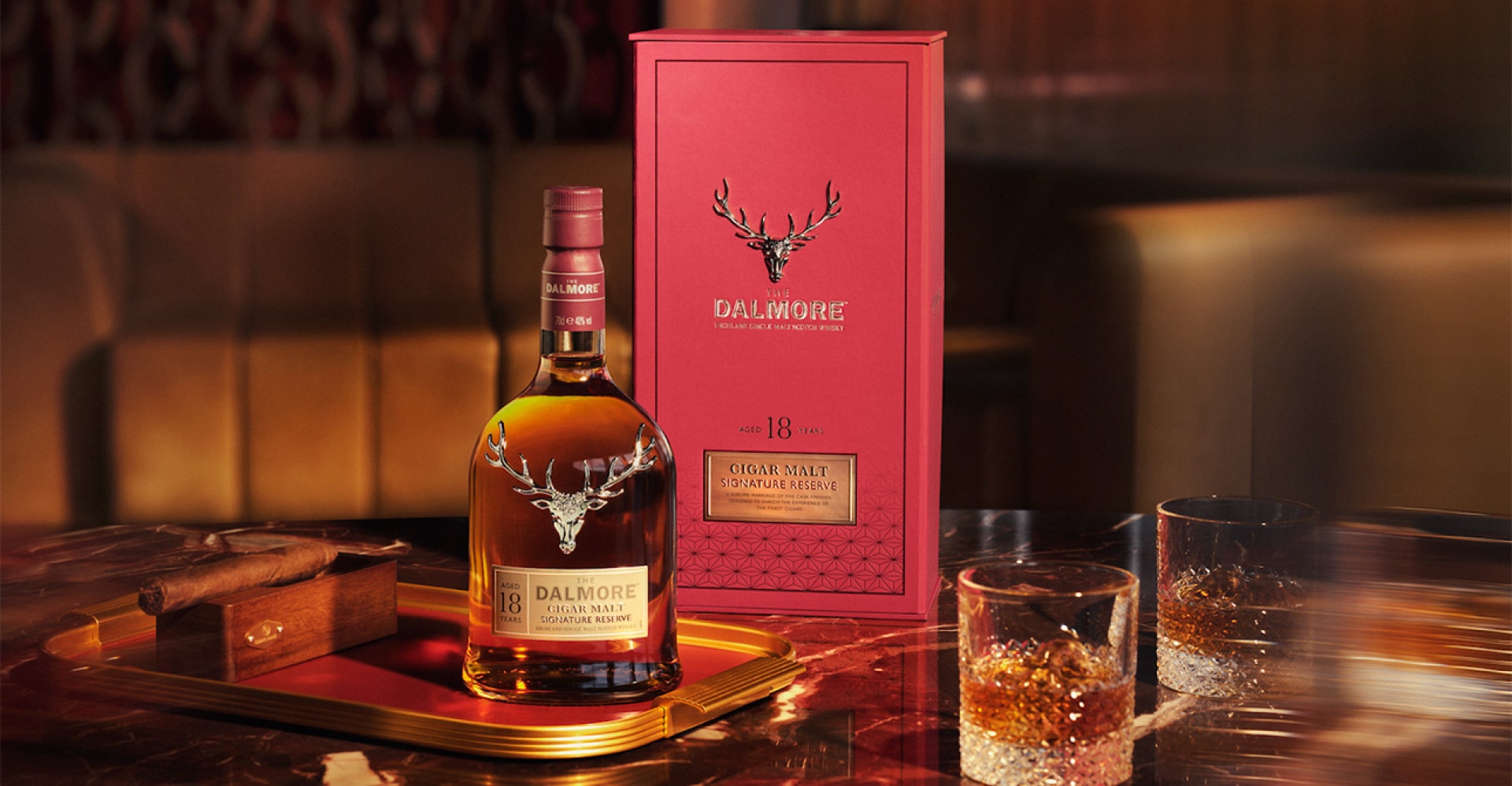

What We're Drinking: Dalmore 18 year old Cigar Malt Signature Reserve
Dalmore’s iconic cigar malt now has an older, more complex sibling
November 17, 2026 –––––– Danny Brandon
Cigar whiskies are plentiful these days, with many brands offering expressions that pair well with stogies, but scotch whisky maker Dalmore first introduced the style in the late 1980s. Back then, master blender Richard Paterson wanted to create a whisky to pair with his favorite Cuban cigar, Partagás Serie D No. 4. After experimenting with various recipes, he eventually landed on a sherry-forward single malt aged entirely in oloroso casks. Dalmore Cigar Malt became widely available in 1999. It was a novel concept at the time, and future scotches from Tomintoul, Tamdhu, and others would also leverage sherry casks for the same purpose.
Dalmore Cigar Malt has undergone a few changes since its launch, including a short-lived rebrand as Dalmore Gran Reserva. It was briefly discontinued in the late 2000s before returning a few years later as Cigar Malt Reserve—the current incarnation—with an altered recipe intended to expand its compatibility with other cigar types. The distillery now releases Cigar Malt Signature Reserve, a new, older cigar whisky that will join Cigar Malt Reserve as a permanent release.
Complex Recipe
Unlike its predecessors, the new Cigar Malt Signature Reserve has an 18 year old age statement. It’s blended from parcels aged 16 years in bourbon barrels, then finished 2 years in matusalem oloroso casks, French oak marsala casks, French oak cabernet franc barriques, or French oak cabernet sauvignon barriques. It was bottled at 46% ABV, without chill filtration or caramel coloring.
Predecessor Cigar Malt Reserve leans heavily on Matusalem sherry casks (about 70% of the recipe), which are blended with other parcels aged full-term in bourbon barrels (around 20%) and cabernet sauvignon barriques (around 10%). Dalmore hasn’t disclosed the blending breakdown for the newcomer, but marsala casks and cabernet franc barriques are new inclusions for Signature Reserve. Its proof is also slightly higher 44% ABV. Depending on how much is used, these additions should help the whisky better stand up to bolder cigars. According to Dalmore the cabernet franc casks add wood spice, subtle savory character, and complexity. The marsala casks bring warming spice and crystallized ginger.
Dalmore is best known for its sherry cask finishing, but the distillery also occasionally finishes using other wines like these. Cabernet sauvignon prominently shows up in its King Alexander III expression, the ultra-aged Dalmore 45, and The Quartet, among others. Marsala casks are a bit more uncommon, also included in King Alexander III and getting the spotlight in this year’s Dalmore Select expression. Cabernet franc is the least used of the trio, with Cigar Malt Signature Reserve being the only Dalmore expression in recent memory to do so.
For some of its other expressions, Dalmore explores specific wine regions rather than grape varieties/styles. Châteauneuf-Du-Pape, a prominent French wine region located in Southern Rhône, stands out. It headlined one of Dalmore’s prestigious Cask Curation Series editions, which saw the distillery work with the Château Mont-Redon winery to finish three well-aged malts. Bordeaux wine casks also see some action at the distillery, showing up in Dalmore Luminary No. 3 and the Portfolio Series, among others.
How Does Dalmore’s New Cigar Malt Taste?
93 points-Dalmore 18 year old Cigar Malt Signature Reserve Highland Single Malt
ABV: 46%
SRP: $400
Availability: Nationwide
The four wine cask finishes make themselves known very quickly, with aromas of plum, raisin, sweet ginger, milk chocolate, and blackberry arising from the glass, with a few drops of water revealing ripe apples. The palate has cranberry sauce, ginger ale, gentle tannins, baking spice, dark chocolate, chai, barrel spice, and more raisins. The finish adds Christmas cookies, chocolate mousse, marmalade, and orange. Well balanced, with interesting interplay between fruit and spice across the profile.