
Whisky of The Week: Fettercairn's 12 and 16 Year Olds
These two anchors in the core range earned high ratings
May 4, 2026 –––––– Danny Brandon
Though it’s an old name in scotch whisky, Fettercairn has been relatively obscure. Some of the Eastern Highland distillery’s lack of stardom comes from the fact that for nearly all of its 200-year history, its single malts were not sold in the U.S. in any significant way. It’s a fairly small operation to boot, with an annual production capacity of 2.15 million liters of pure alcohol—roughly one-tenth the size of major distilleries like Glenlivet and Glenfiddich. Since 1973, Fettercairn has been part of the Whyte & Mackay portfolio alongside other distilleries like Dalmore, Jura, and Tamnavulin, and most of its malts have been made for the flagship Whyte & Mackay blended scotch label. Some independent bottlers like Signatory, Gordon & MacPhail, Douglas Laing, and A.D. Rattray bottled and released Fettercairn single casks in the U.S. that were generally praised for their quality, but official single malt bottlings were unheard of Stateside.
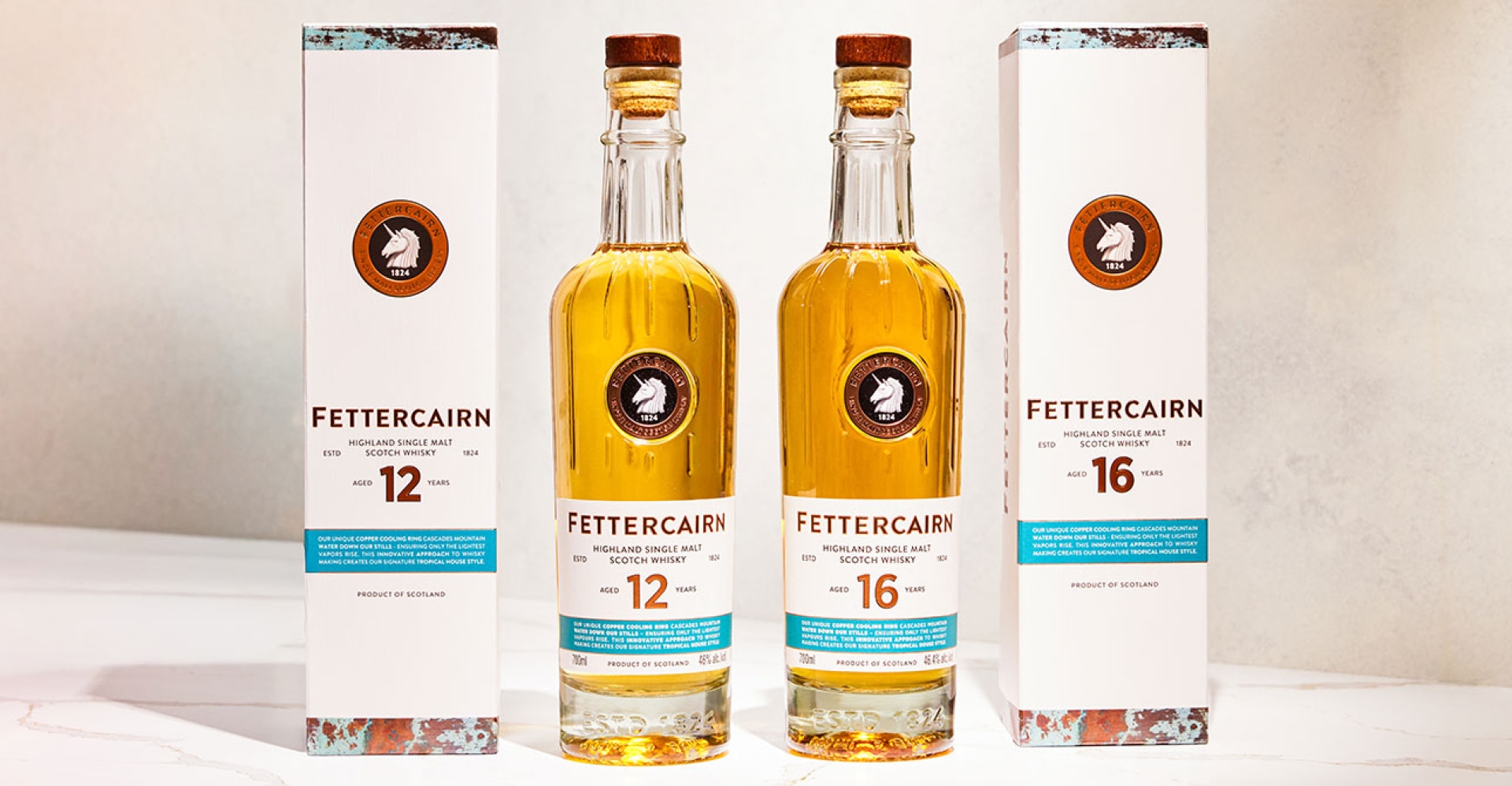
Last year, Fettercairn embarked on a renewed effort in the U.S. market. It was a fairly unconventional debut: Rather than starting with entry-level bottlings, it hit our shores with two ultra-aged expressions: a 24 year old ($650) and a 28 year old ($1,250). Both whiskies were impressive, but the suggested retail price put them out of reach for many. But now Fettercairn has released the first bottles in its U.S. core range, a 12 and 16 year old single malt, and we got a chance to taste them.
Tropical “Waterfalls”
The 12 year old is bottled at 46% ABV rather than its 40% UK counterpart. Both whiskies are aged exclusively in American oak bourbon barrels and were bottled at natural color and without chill filtration.
Fettercairn’s house style is generally very tropical and spirit-forward, mainly due to what Fettercairn calls “waterfall stills.” The stills are fitted with copper rings that wrap around the upper part of the neck, just below where the lyne arm begins to curve. During distillation, while the team is making its middle cuts, the ring starts to pour cold water over the exterior of the still’s head, thereby rapidly cooling the copper. As distillery manager Stewart Walker explains, the cooler temperature makes it harder for heavier vapors to rise in the still, ensuring that only lighter vapors reach the lyne arm and into the final product.
The waterfall stills are one form of flow management, which aims to shape the spirit’s taste profile by controlling the level of reflux. Fettercairn’s sister distillery Dalmore has a similar system that uses water jackets paired with flat still heads that increase reflux. Glenmorangie’s “giraffe” stills are the tallest in all of Scotland—standing at just over 16 feet tall, the same height as an adult male giraffe—which increases reflux and lightens the spirit. Ardbeg has long increased reflux with a purifier, a copper apparatus installed between the lyne arm and condenser that traps and redistills heavier vapors. At the other end of the spectrum are distillers like GlenDronach, who use short, fat pot stills with downward-sloping lyne arms to minimize reflux and achieve a heavier spirit.
More Fettercairn whiskies are expected to reach the U.S. in the future, though the exact details are undisclosed. In the meantime, we’re quite happy sipping the ones that have already been released.
What do Fettercairn 12 and 16 Year Old Scotch Single Malts Taste Like?
93 points Fettercairn 16 year old Highland Single Malt
ABV: 46.4%
SRP: $120
Availability: Nationwide
Tropical notes of lemon and lime, tea, chocolate sweetness, and orange peel. Full review here.
92 points Fettercairn 12 year old Highland Single Malt
ABV: 46%
SRP: $55
Availability: Nationwide
Bananas, apples, pineapple, and passion fruit, with maltiness and vanilla. Full review here.