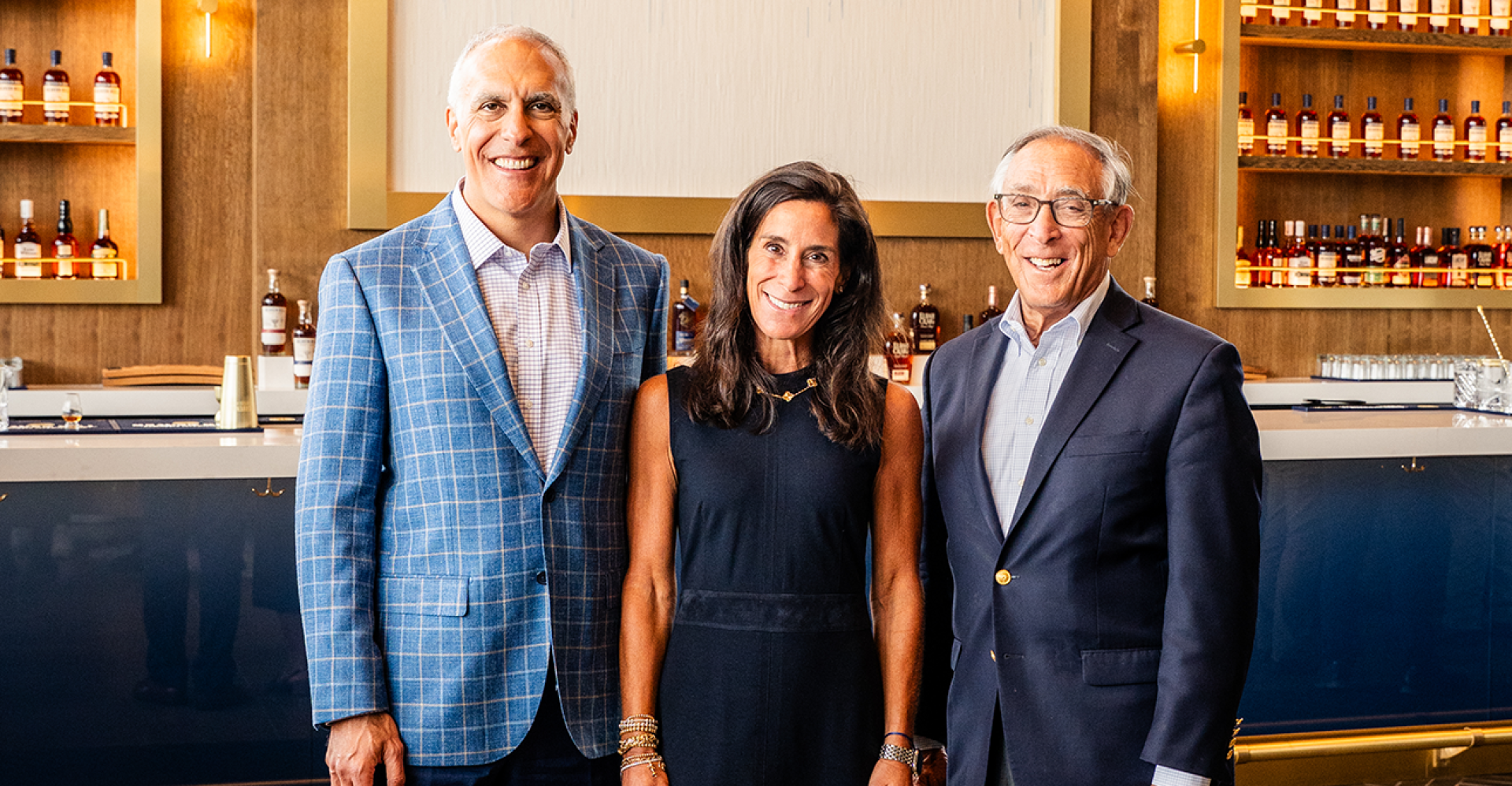
Heaven Hill co-presidents Allan Latts and Kate Latts, and her father and executive chairman Max Shapira.

After 90 Years, Heaven Hill Sees Opportunities
Max Shapira and Kate Latts discuss their family's Depression-era startup, navigating industry headwinds, and why they're still investing in whiskey's future
December 4, 2025 –––––– Sean Evans
For nine decades, Heaven Hill has turned challenges into opportunities, building America's largest independent, family-owned distillery from a Depression-era startup with no inventory, no warehouses, and remarkably, no brands. As the country's second-largest holder of bourbon barrels marks its 90th anniversary, Heaven Hill executive chairman Max Shapira and his daughter, Kate Latts, the company’s co-president, are doing what their family has done best for three generations of leadership: taking the long-term view.
Industry alarmists cite decreased consumption habits by younger drinkers, the cooling of the bourbon category, and agave’s steady rise. The Shapiras have seen similar cycles before; Max has been with the company for 55 years. Heaven Hill just opened Heaven Hill Springs, a new $200 million distillery in Bardstown, doubling down on bourbon's staying power while continuing to evolve the company’s tequila pipeline through its Tequila Ocho brand.
In this Q&A with Whisky Advocate, Shapira and Latts discuss the big wins and losses, the patience that defined Latts’ grandfather's generation, the forecasting challenges that remain murky, and why they remain bullish on bourbon's future.
Whisky Advocate: Thanks for taking the time for us. Congratulations on your 90th anniversary. What are some of the biggest highs over the last nine decades for Heaven Hill?
Max Shapira: Getting started! I say that jokingly, but actually, that was a highlight. Our business started on December 13, 1935, in the middle of the worst economic conditions: the Great Depression. Prohibition had ended two years prior, and my dad [Ed] and his brothers started the business with no inventory, no distillery, no warehouses, no brands for goodness sakes, nor knowing how much whiskey to make. Then, ultimately, having to wait and wait and wait to see if all of this may make sense. My dad told me several times that they waited until they thought they had a product of great quality. There’d been so much bad whiskey during Prohibition that they needed patience and perseverance to make it just right. In 1939, Old Heaven Hill Bottled in Bond launched, and it quickly became the largest-selling whiskey in Kentucky. It not only put us on the map, but it made [my dad and his brothers] realize this could develop into something bigger.
Kate Latts: When my dad came into the business in 1970, we knew that the company would endure into the next generation. Until then, we had been an American whiskey company. Dad saw consumer tastes changing and the need to diversify, developing vodka, gin, rum, and tequila. Capitalizing through the ’80s and ’90s, during a big consolidation period, we saw growth through acquisitions. That whole time period was a major high.
WA: To celebrate your 90th, you released a special expression, Heaven Hill 90th Anniversary Kentucky straight bourbon. What was the process for making the final product?
Latts: It’s a 9 year old straight bourbon, mostly our original mashbill [of 78% corn, 12% rye, and 10% barley]. Of that, we placed 70% in regular barrels, then 30% in heavy-char barrels to add extra dimension. We bottled at 107 proof, and only 204 barrels were selected for this release. I’ll add that the barrels for this release were produced on our 80th anniversary, a decade ago.
WA: Any hints as to what you’ll be cooking up for your centennial anniversary?
Latts: We may earmark some of what gets produced this December 13th to save for our 100th anniversary…
WA: You’re known for making quality whiskeys at approachable price points. However, you’ve had a noticeable shift to higher-margin releases, especially with the 2022 acquisition of Samson & Surrey, for example. How’s that going?
Latts: We evolved our own bourbon portfolio in our way, and our premiumization has evolved with many of the brands during the Samson & Surrey merger, including Widow Jane bourbon and Tequila Ocho [premium estate-grown agave]. We’re fortunate to have Tequila Ocho and [entry point tequila] Lunazul. And we have great capacity in between our [Bernheim and new Heaven Hill Springs] distilleries now. We’re not in an “our hair is on fire” place, like we were when we had one distillery a few years ago and were figuring out how hard it can run. Now we can continue to experiment. With tequila, we’re at the start of that growth period; we’re working hard to scale our [Mexican] capacity to meet demand.
WA: What’s your read on how the growing bourbon glut will play out?
Shapira: The interesting thing is everyone thinks today’s headwinds are something unique and different. We’ve experienced all of this before in our 90 years: a slowdown in bourbon from 1960 for three decades, consumers wanting to be healthier. We’ve been able to navigate this by understanding what consumers want. Evan Williams started in 1957, and we were able to grow it throughout the ’80s and ’90s, during uncertainty about the category.
WA: What about the data around lower consumption habits for Gen Z?
Shapira: The Gen Z demographic is talked about as if we know what they’re going to do in 5, 7, or 10 years. All I know is that a bunch of those people aren’t even of legal drinking age. We’re ready to throw everything aside for a group of people who can’t even buy alcohol? That’s premature.
WA: Given these uncertainties, how are you currently making future production decisions?
Shapira: It’s unbelievably complicated! We make the forecasts for each year by brand with a sophisticated processes and many spreadsheets—but still I joke that in all the years I've been doing it, I don’t know that we’ve ever been exactly right.
WA: A big chunk of the industry is going through layoffs. Heaven Hill hasn’t. What does it take to ensure you’re not reducing your employees?
Latts: As Heaven Hill has grown over the past decade, the business has gotten more complex across the categories. In contrast to seeing the industry needing to downsize, we continue to add new capabilities and roles. People had to wear more hats when we were smaller; we need more specialists now. It’s been exciting to hire data scientists, commercial finance people, and consumer market insight resources. These are areas where we continue to grow.
WA: How do you think the industry will change over the next 5 or 10 years?
Shapira: We think alcohol beverages will play a part of the consumer's life for many years to come, across all categories. Consumption patterns will continue to change, but people will continue to enjoy alcohol. One thing I think will change is the way we go about getting answers [about consumer behavior], and that’s through AI. It will play an important part in how we define the consumers. Wouldn’t it be amazing if we could locate one person at a time and send a message only for that one person? Maybe that’s on the outer edge of our thinking, but technology will continue to become a significant part of things.