
Karuizawa's 43rd Bottle: The Mystery of Cask 5627
Sotheby’s star bottle raises questions about cask strength Karuizawa
September 16, 2026 –––––– Jonny McCormick
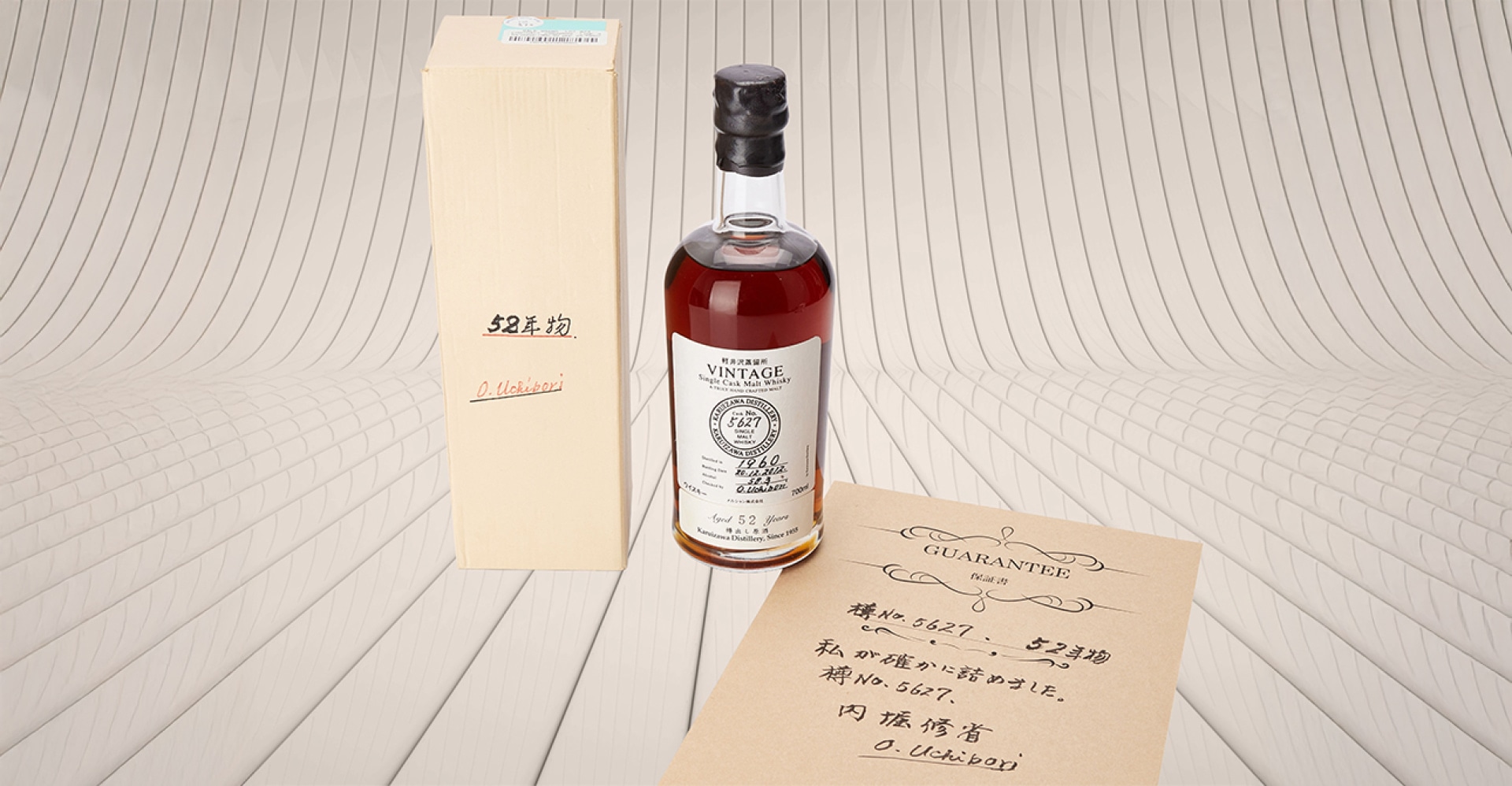
On September 18th, Sotheby’s in New York will put a bottle of Karuizawa 52 year old single malt distilled in 1960 on the auction block. Sotheby’s has dubbed the black wax-sealed bottle “The Prototype.” It has a simple Mercian Company printed adhesive label signed by Karuizawa’s last master distiller, the late Osami Uchibori. A second smaller label showing the age statement sits below the main label. The lot includes a handwritten guarantee in Uchibori's handwriting confirming that he bottled it, and the bottle is presented in a simple carton that also bears his handwriting. The bottle reportedly was one of two drawn by Uchibori from cask 5627 on different days. Sotheby’s Global Head of Spirits Jonny Fowle has described it as a career highlight and the most important Japanese whisky to come to market in recent years. Sotheby’s has valued the bottle at $400,000–$600,000.
That cask number might be familiar. It yielded 41 bottles for a Number One Drinks Company (NODC) release, bottled at 51.8%, on January 1st 2013. At the time, it was the oldest Japanese whisky ever released. The NODC release featured an individual netsuke figurine, ensuring no two bottles were the same. Each bottle had twin washi labels, a washi paper cap over the wax seal, and came in a wenge-and-ash wood box. In 2015, and again in 2017, the NODC release held the auction record for the most expensive whisky ever sold at auction. In May, Karuizawa 1960 52 year old Cask No. 5627 Treasure Ship sold for $638,007 in Hong Kong. At the time of writing, it is the second-highest hammer price for whisky at auction in 2026.
Sotheby’s has not stated why this bottle exists. It has an ABV of 58.3%. It is not part of the record-breaking NODC Karuizawa 1960 52 year old release, and has none of the secondary packaging. Sotheby’s did not disclose the fate of the other bottle; it may have simply been a cask sample used by a blender to prepare the NODC Karuizawa 1960 52 year old release. It is still an event when one of the NODC bottles comes to auction; whisky collectors have been told the thirsty angels had only left 41 bottles since release. Now we know there were 43 bottles. Sotheby’s has not disclosed the provenance of this particular bottle either, so it’s unknown whether it was Mercian Company property, from the Uchibori estate, from the NODC founders, or from a private collection unrelated to the parties involved with the release. Cask No. 5627 was a 250-liter sherry hogshead, so assuming the cask was filled completely in 1960, 88% of its volume could have been lost over the 52 years until it was bottled. While evaporative cask loss doesn’t occur as a linear process, this works out to an angels’ share of 3.9% per year.
There are other anomalies in the story. The Sotheby’s bottle was filled on December 20th 2012 at 58.3%, while the NODC release was bottled at 51.8% on January 1st 2013. This indicates that the whisky’s ABV dropped dramatically by 6.5% in 12 days. An explanation for this unnatural phenomenon is that the NODC Karuizawa 1960 52 year old single cask, once the most expensive whisky ever sold at auction, was not bottled at the natural cask strength and was diluted down to 51.8% for either flavor optimization reasons or to ensure there was sufficient volume for a release of 41 bottles. That perhaps strengthens the argument for drawing two bottles for internal use: first, to have a bottle for sampling by potential buyers in order to sell the cask to an independent bottler, and second, in order for the distiller to determine that 51.8% was the preferred drinking strength for NODC to present this whisky to the world. The bottler would have needed to add 3.2 liters of water to the 58.3% stock volume to dilute the remaining volume to 51.8% and expand the total liquid to a volume sufficient for 41 bottles. This raises further questions about whether other valuable high-strength single cask Karuizawa releases circulating in the secondary market are actually bottled at natural cask strength or the bottler's preferred strength.
Karuizawa has a history of split cask releases. The Mercian Company labels on the Sotheby’s bottle are the same as this Karuizawa expression from Cask No. 6177, distilled in 1970, signed by Uchibori, and bottled at 31 years old in 2001 at 64.3% ABV. Although the auction site identifies it as an independent bottling by NODC, that company wasn't formed until 2006. This was a distillery bottling, labeled and sold at the Karuizawa visitor center, which continued to operate for a period after the distillery ceased production in 2000. Number One Drinks Company bottled a 42 year old whisky from the same sherry cask, Cask No. 6177, in 2012, with an identical ABV as the Uchibori bottling 11 years earlier. Given the possibility that this cask also experienced evaporative losses of around 3.9% per year, the odds of retaining an identical ABV 11 years later seem slim. There are other better-known split cask releases where there are no discrepancies in the number of bottles or ABV, such as Karuizawa 1967 Cask No. 6426, which was bottled in 2009 into a release marking the 10th anniversary of The Whisky Exchange online store in the UK, as well as this vintage release for La Maison du Whisky, Paris. Both were bottled at the same time, however, so they have the same ABV.
The Japanese whisky industry has tried to introduce countermeasures to assuage the global whisky industry’s concerns about transparency and labeling of Japanese whisky. The JSLMA guidelines and stamp are far from universally applied and applicable only to the member companies of the trade body. These Karuizawa bottlings predate all such measures, but details shared by the sale of this Karuizawa bottle have inadvertently raised questions about the accuracy of the bottling numbers for one of the world's most collectible whiskies, and whether seemingly natural cask strength bottlings were proofed down by the bottlers.