
Inside Stranahan's Mountain Angel 14 Year, the Distillery's Oldest Expression
Head blender Justin Aden takes us through the single malt’s time in American oak, cognac, and tokaji barrels
November 3, 2026 –––––– Sean Evans
By 2018, Stranahan’s had been making whiskey in Denver for 14 years, long enough to release a bottle bearing that age statement. It took another eight years before one was unveiled.
“I’m proud we didn’t do it the day we turned 14,” says Justin Aden, the distillery’s head blender.
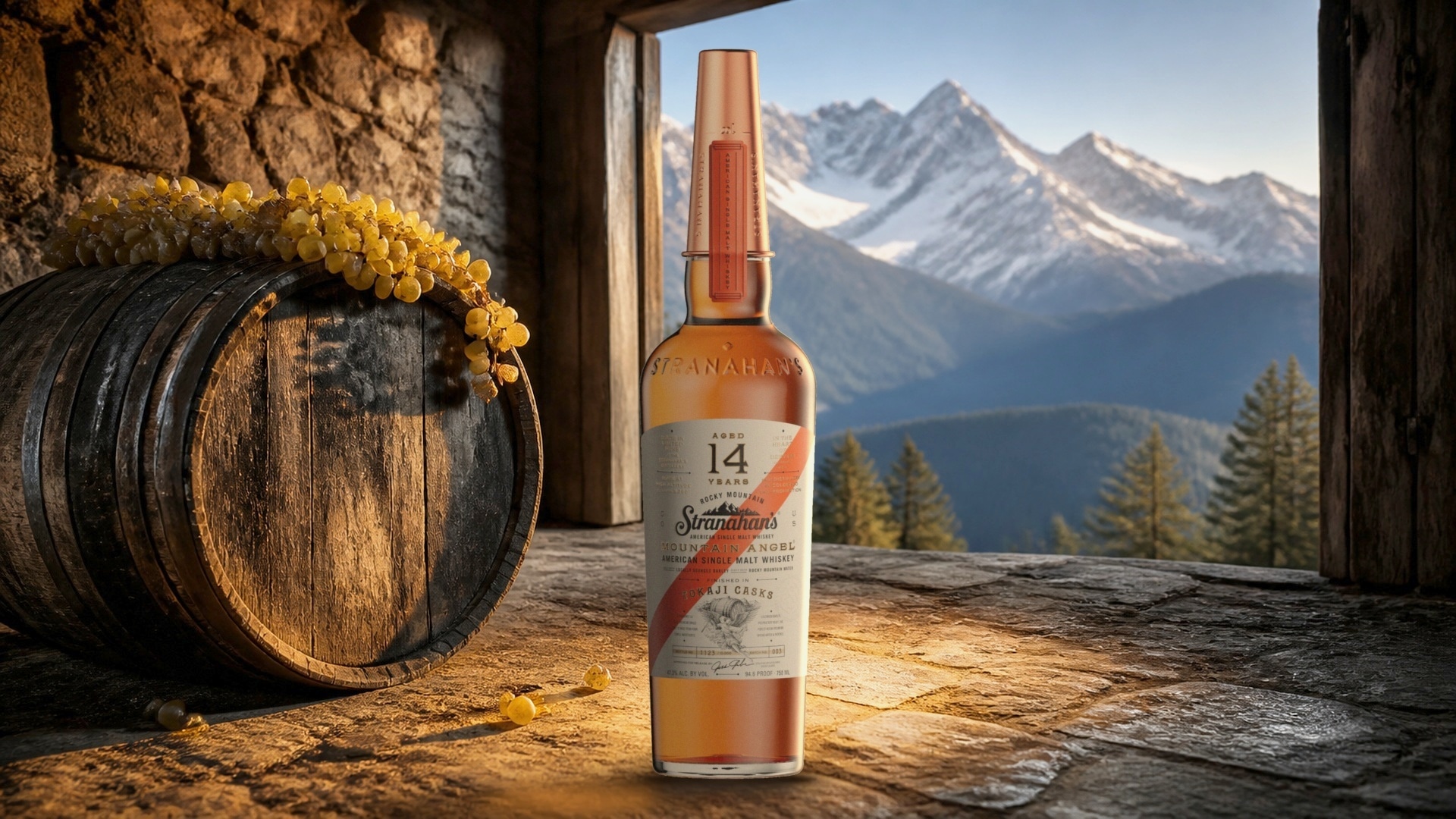
The resulting whiskey, Stranahan’s Mountain Angel 14, is the distillery’s oldest expression released to date. It joins the Mountain Angel series, which explores what happens when Stranahan’s American single malt ages for more than a decade. Earlier Mountain Angel releases carried 10 and 12-year age statements; this latest pushes that exploration two more years and into three types of oak.
“Mountain Angel specifically is calling attention to the aging in mountains,” says Aden. “At our elevation [5,280 feet] and with low humidity and atmospheric pressures, whiskey ages differently. Proof climbs slowly and methodically. It doesn’t get hot in the summer where extraction is happening really fast, and Denver’s not a tundra in the winter, so the temps are high enough where things inside the barrel never go dormant,” Aden explains. “This puts us in a unique position to go higher in age statements than you’d expect in, say, a Kentucky bourbon without overextraction.”
Mountain Angel 14 arrives this month at $120 and 94.6 proof, with 1,860 bottles available this year and more than 6,000 expected in 2027. Getting there involved years of trials with different finishes and maturation periods, some begun by Aden’s predecessor.
All the whiskey in this expression was distilled in 2012. “Back then, a lot of people who knew Stranahan’s DNA would call out a cognac grape-skin flavor to our malt,” he said. “There’s always a bit of apple in well-made malt mash, green apple and pear.” To Aden, cognac or calvados casks seemed natural candidates for developing those flavors. First, though, came 9 years in new American white oak barrels with a No. 3 char. “This puts a lot of America in American single malt,” Aden adds. “Aside from jazz music, our greatest contribution as a country is the American white oak barrel.”
The whiskey was then transferred into French limousin oak cognac barrels holding approximately 450 to 475 liters. Some had spent 20 to 40 years aging cognac before making the trip to Colorado, where keeping them sealed required attention. “French oak tires out sooner, due to a tighter grain. Add in our elevation, and these didn’t want to hold liquid as much. These were very ornery barrels,” Aden laughs.
After 3 to 3.5 years, the whiskey had developed, but its familiar fruit profile still dominated. “That blend tasted too much like the base whiskey,” says Aden. “Not a bad thing, but not our vision for the Mountain Angel range.”
The unfinished Mountain Angel 10 already explored that house character at an older age. For the 14, Aden wanted to take it somewhere else. Enter freshly emptied tokaji barrels from a major Hungarian producer. Aden has a fondness for tokaji, having worked with these wine casks before, including for its 2024 Snowflake release, Red Peak.
“I love tokaji,” he says. “There are six different levels of sugar used to grade tokaji, sugars that are added to the barrel. There’s a beautiful array of sucrosity to play with if you get your hands on good barrels. Hungarian oak is a lot like French oak but slightly less tannic; there’s more terroir and more vanilla than in French—though not as much as American oak. For all these reasons, it’s great to work with.”
Tokaji brings the freshnessAden wanted, along with honey, fruit, and warm baking spices associated with Hungarian oak, flavors and texture that enhance the older spirit. Emphasis on older, here. “We’re playing with notes at a moment in time with our whiskey,” he says. “I don’t love tokaji finishes with our whiskey at 5 or 6 years of age. It’s not the most complementary at that stage. But here, in the 14, it’s perfect.”
In the glass, the tokaji shows up well. My first nosing finds raisins, honey, apples, and pears, followed by hay, chocolate shavings, and shortbread cookies. Raspberry emerges beneath spicy oak notes. The nose is soft and approachable, with enough going on to compel multiple whiffs.
Aden recommends giving it time to open up. “The nose gets earthier after 5 or 10 minutes, but the palate stays juicy,” he said. On my palate, the whiskey is bursting with flavor. Apples arrive in every form: juice, butter, and pie. Orange and raspberry hit the tip of the tongue before a nutty, tea-like dryness builds toward the back, accompanied by a spreading warmth.
The finish keeps bringing me back to fresh apples, pears, and berries, as though I’d taken a deep breath over a basket just picked at the orchard. Dried flowers and barrel spice follow, with enough tannic grip to give all that fruit some structure. It’s a deeply pleasing whiskey, with a ton of complexity and layers. You could sit with it for an hour or two and never get bored.
Mountain Angel 14 may also offer a preview of what’s coming the first weekend of December, when Stranahan’s releases this year’s Snowflake. Aden expects it to be the oldest in aggregate in the annual series, though that won’t translate to a stated age on the bottle. Components from Mountain Angel 14 are among those under consideration. “You may see some of these familiar things in Snowflake,” he says, “since they’re top of mind.”