
Marvin R. Shanken, Visionary Publisher Who Transformed the Worlds of Wine, Spirits, and Cigars, Dies at 83
As the Editor and Publisher of Wine Spectator, Cigar Aficionado, Whisky Advocate, and more, Shanken built a publishing company with a focus on educating consumers
October 29, 2026 –––––– Mitch Frank
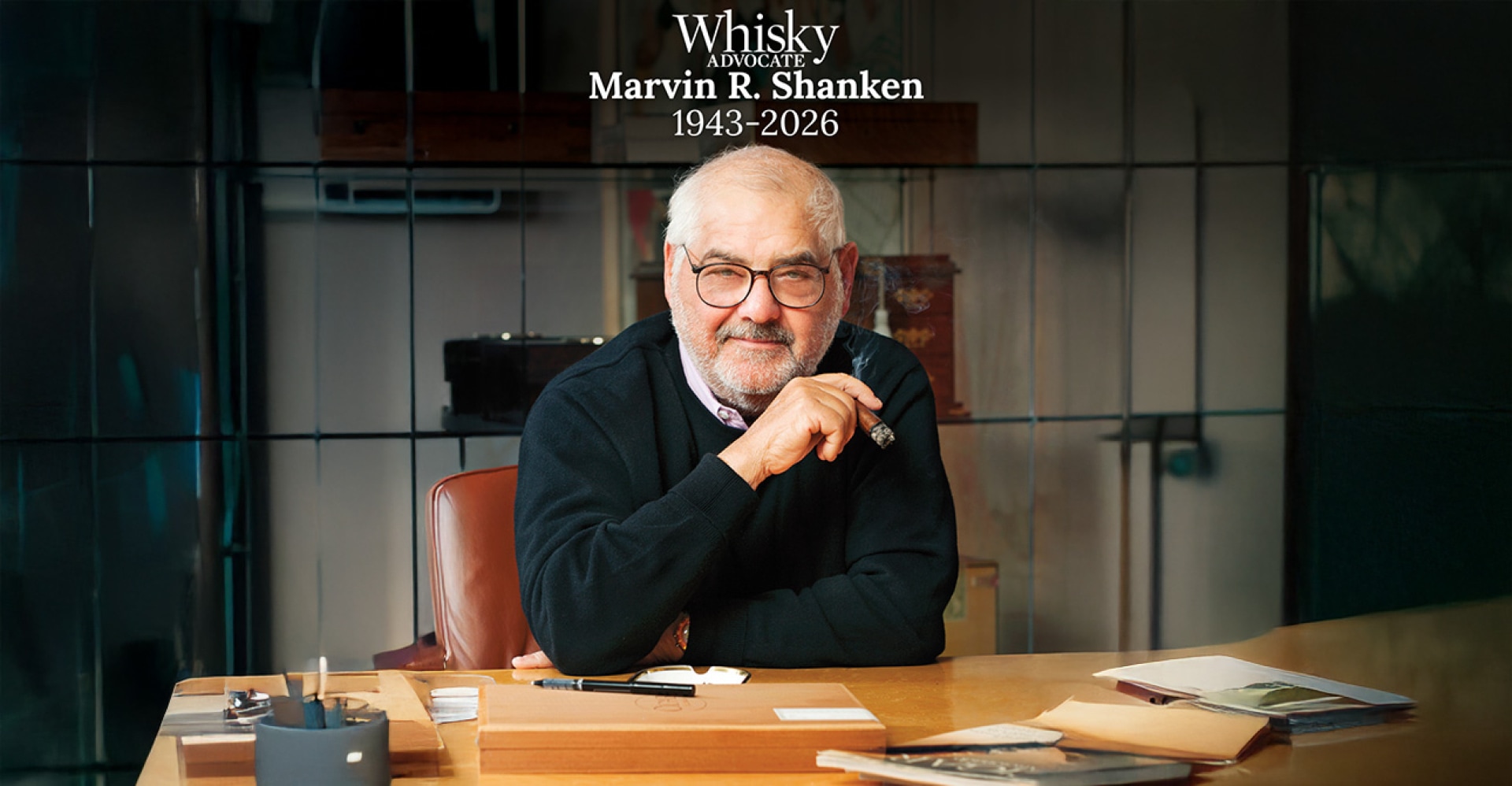
Marvin R. Shanken, the founder of M. Shanken Communications Inc. and the editor and publisher of Wine Spectator, Cigar Aficionado, Whisky Advocate, and other magazines, died on October 29. He was 83 years old. Over a five-decade career, Shanken dramatically shaped the wine and cigar worlds, as well as the spirits, beer, and restaurant industries. He helped educate millions of Americans on the joy and virtues of wine and ignited interest in handmade cigars, transforming a once-struggling industry.
Shanken began his publishing career in 1972, when he purchased a small beverage alcohol industry newsletter named Impact. Within a decade, he turned it into essential reading for thousands of members of the spirits and wine industries. In 1979, he purchased a struggling newspaper given away for free at wine shops named The Wine Spectator, which he would grow and then transform into a glossy magazine prized by more than three million wine lovers as essential reading.
In 1992, he released the premiere issue of Cigar Aficionado, a magazine he created based around his longtime love of cigars. Shanken also founded the trade publications Market Watch and Shanken News Daily, and purchased Food Arts and Malt Advocate, which he renamed Whisky Advocate in 2011.
An Unexpected Detour Into Journalism
Marvin Ray Shanken was born on October 4, 1943, in New Haven, Connecticut, not far from Yale University, though he liked to joke, “I didn't go to Yale. The closest I got was the Yale Bowl, where I sold cold beer on weekends.'' His father, Oscar, ran a small jewelry store.
After high school and a summer stint volunteering for John F. Kennedy’s 1960 presidential campaign, Shanken studied business at the University of Miami. He became a devoted Hurricanes fan and would later serve as a member of the University’s board of trustees, but in 1965, he graduated last in his class, which he often joked about. He hoped to study for an M.B.A. from American University in Washington, but the school would only accept him if he first took night classes. ''I got straight A's,'' he later told The New York Times. “They had to let me in.''
In 1968, Shanken got a job on Wall Street with a small investment banking firm, primarily working on real estate investments. Two years later, he was dispatched to California to help finance a vineyard purchase for a client. While doing due diligence on the wine industry, he was surprised to find out there was almost no public information.
After the deal was complete, the client took Shanken out for dinner at an elegant French restaurant in Westchester County, N.Y., called La Crémaillère, and told him he could order any wine on the menu. “Frankly, I’d never had any great wine before,” he later told Wine Spectator, “but there was one I’d heard of, so I ordered it: 1961 Pétrus. We drank it, and bells went off. I loved the taste and wanted to learn everything I could about wine.”
With no experience and $5,000 he borrowed from his sister Elaine, he bought the Impact newsletter from Jack Maxwell, a research analyst at Oppenheimer & Co. Maxwell handed him a box with 200 index cards—Impact’s subscribers. For the next three years, Shanken ran Impact part time while continuing his day job.
“Within the first three months, I was certain I had made the biggest mistake of my life,” he later said. “I had jumped out of an airplane without a parachute.”
Impact was a trade newsletter analyzing the wine and spirits industries. In the 1970s, most of these companies were privately owned and kept their financials to themselves. Most trade publications simply reprinted press releases. “I quickly learned the liquor industry was a closed kingdom, controlled by a small group of liquor barons. They didn’t want outsiders,” Shanken said. “To suggest that I was unwelcome would be an understatement.” Shanken remembered attending a conference where he tried to introduce himself to various industry titans, who all pointedly ignored him.
But while the producers did not want independent, professional journalism digging into their finances, alcoholic beverage wholesalers did. They proved to be Shanken’s early supporters, buying subscriptions for their staff and retailer customers. In 1975, he quit his day job and began working on Impact full time, with one other employee. As he was recently divorced, his offices were the one-bedroom apartment on Manhattan’s East 53rd Street in which he lived.
Slowly but surely, he found success. In 1976, Impact published its first annual research study, an in-depth look at volumes and sales figures of the alcohol industry, which has now grown into a series of reports called Shanken’s Impact Databank. In 1977, he held the first annual Impact Marketing Seminar, a daylong event for industry leaders to discuss trends in marketing, advertising, and government regulation. He hoped for 50 people, and 125 showed up. Impact quickly became essential reading.
A White Knight for a Wine Magazine
The Wine Spectator (today it is known simply as Wine Spectator) was founded in San Diego in April 1976 by Bob Morrisey. A free tabloid newspaper, it was distributed in local wine shops. Shanken saw it on a trip and loved it. “It was simple, unpretentious and entertaining for consumers,” he said. He called Morrisey to compliment him, and the two men became friends, regularly chatting about their respective publications.
But by 1978, Morrisey was struggling to keep it afloat and offered to sell it to Shanken. Turning him down, Shanken instead traveled to San Diego and spent several days offering ideas for turning it around. But a year later, Morrisey reached out again—if Shanken wouldn’t buy The Wine Spectator, it would cease publication. “He flew to New York, we met, and somehow he got me to agree. I think the only reason I agreed to do it is that I didn't want Wine Spectator to die."
In the July 16, 1979, issue, Shanken’s first as publisher, he wrote an editorial titled, “You ain’t seen nothin’ yet.” At the time, circulation was 5,000 issues. Shanken’s goal was to transform it from a newspaper to a magazine, but that would require time and money. “I was never satisfied with it as a newspaper, but you have to crawl before you walk, walk before you run, and to print a newspaper costs a fraction of what a magazine in full color does,” he later said. “And so every year my goal was to grow the revenue, hire more people, to the point where one day, I could take it from a newspaper to a magazine and educate people all over America about wine. I’ve said from the beginning: We’re not in the publishing business; we’re in the education business.”
In 1985, the magazine adopted the 100-point scale for rating wines, in order to give American consumers a format that easily resonated. That system would later become the foundation for another magazine, one that would ignite a boom in a completely different industry.
Changing The Cigar World
Shanken’s love affair with cigars began 65 years ago, when he was a college student at the University of Miami. “I started smoking Hav-A-Tampa Jewels, which were then 25 cents for a box of five,” he said in a 2012 interview in Cigar Aficionado. At the time, cigars were not as embraced as they are today. “I was probably the only kid smoking cigars in my fraternity,” he said. “I was a loner in the cigar world.”
In 1991, after a landmark trip to Cuba, he published a cover story in Wine Spectator called “The Allure of Cuban Cigars.” On his return voyage to the United States, he had an epiphany. “In the airplane, I said to myself I don’t want to die without having a cigar magazine.”
In the fall of 1992, the first issue of Cigar Aficionado went on sale. His entire management team had discouraged him, arguing there wasn’t a large enough audience to support his idea, yet the magazine became a success. A 1994 one-on-one interview with Fidel Castro, then the president of Cuba, helped popularize the magazine, as did Shanken’s $575,000 purchase of a humidor once owned by President John F. Kennedy, acquired at a highly publicized Sotheby's auction of the estate of Jacqueline Kennedy Onassis in 1996.
Cigar sales surged after the magazine’s debut. In less than five years, the number of premium, handmade cigars imported into the United States quadrupled, from roughly 100 million units to well over 400 million units, transforming the industry.
Shanken interviewed many of the people who appeared on the cover of Cigar Aficionado, a list that includes such luminaries as Michael Jordan, Arnold Schwarzenegger, Robert De Niro and Francis Ford Coppola. Other covers have featured such stars as Sylvester Stallone, Jack Nicholson, Danny DeVito, Demi Moore, Tom Selleck, Michael Strahan, Pierce Brosnan, Bo Derek, Wayne Gretzky, Denzel Washington, Claudia Schiffer and Bill Murray. Today the magazine has a readership of 1.3 million people.
Shanken was honored by his peers with the Association of Magazine Media’s Lifetime Achievement Award in February 2019. “Marvin belongs to the elite coterie of magazine makers, the geniuses of our business,” said Jonathan Newhouse, chairman of Condé Nast International, as he presented Shanken with the award. He praised Shanken’s long history in publishing, particularly his refusal to compromise editorial integrity for advertising revenues. “In today’s media landscape, where the walls between ads and edit are nonexistent, Marvin maintains an iron curtain.”
Giving Back To Those In Need
While he dedicated so much of his energy to his company, Shanken also spent a considerable effort on charity. “From the very early days, we wanted to give back,” said Shanken in a 2016 interview. “Charity and charitable events are an integral part of our company’s culture.” In 1983, he launched the Wine Spectator Scholarship Foundation, and now all net proceeds from The Wine Experience are for the benefit of the nonprofit foundation. Vintners generously donate all the wines for the annual event, which has raised more than $40 million for scholarships and grants to benefit those aspiring to careers in the hospitality and wine industries.
Black-tie cigar dinners for Cigar Aficionado called A Night To Remember, featuring prominent names from the world of Hollywood, titans of business and leading producers of handmade cigars, raised some $30 million for prostate cancer research.
In 2009, Shanken launched a charitable endeavor inspired by a good friend. The professional golfer Ernie Els and his wife Liezl were looking to give back to the community as parents of an autistic child, their son Ben. Shanken and his wife Hazel partnered with them to launch the Els for Autism Foundation and raise money to build the Els Center of Excellence, an education and recreation center for autistic children in South Florida that opened its doors in 2015. The Els for Autism Pro-Am, sponsored by Cigar Aficionado and Wine Spectator, has raised around $20 million.
A Hands-On Leader
Shanken saw his communications firm as a family company. In 1981, he married Hazel Rudy, a financial executive who now serves on the M. Shanken Communications board of advisers. They have one daughter, Jessica Shanken Reid, who is M. Shanken’s executive vice president for business development. Shanken has two daughters from a previous marriage, Samantha Shanken Baker and Allison Cohen. Cohen’s son Jake Cohen works as an advertising account executive for the company.
When not working, Shanken loved dining out, traveling the world with Hazel, and playing golf. He was a cinema buff—favorites included Once Upon a Time in America and Animal House—and a lifelong fan of the music of James Brown. He was a lover of musical theater, including Jersey Boys and the works of Gilbert & Sullivan, ever since he secured a role at age eight in Pinafore at his summer camp in the Berkshire Mountains of Connecticut. Hoping to pass that love along, in 2000, he began sponsoring school field trips for New York City kids to see performances by the New York Gilbert and Sullivan Players.
For five decades, Shanken was the visible, hands-on leader of the company that bore his name. He believed that the company should also function as a family and took pride in the fact that many of his employees had worked for him for decades.
He was also proud of his company’s journalistic ethos. As he told an interviewer in 2020, “We also talk about how we can guarantee that we never mislead our readers, that we maintain the objectivity and the truthfulness that has escaped from journalism to a very large degree in the world. And I’m constantly asking questions of my editors to make sure that our readers know that what they read is the truth.”
Despite overseeing a company, Shanken saw himself first and foremost as an editor. “People think of me as a businessman or an entrepreneur; I’m really an editor,” he said in a 2020 interview. “I spend more time thinking about, planning and working with my editors to execute each issue, in terms of everything from selecting the cover topic to the content, shaping the stories, to getting the photography, to making sure it’s right. That’s where my fingerprint is, but nobody necessarily knows that. I consider myself more of an editor than anything else.”
Shanken is survived by his wife Hazel, his sisters Elaine and Susan, his three daughters Samantha Shanken Baker, Allison Cohen, and Jessica Shanken Reid, and four grandchildren: Jake, Lauren, Asher and Jordan.