
Inside Dalmore's Newly Reopened Visitor Experience
The distillery’s tour is a 3-hour journey that takes you through Dalmore’s history, distilling methods, barrel selection, and warehousing, all capped by a bespoke whisky tasting
April 27, 2026 –––––– Jonny McCormick
The Dalmore has reopened its distillery to visitors after nearly four years, following a multimillion-dollar renovation that doubled capacity and created a new visitor experience. The official opening is today, April 27th.
Situated along the North Coast 500 by the Cromarty Firth, Dalmore is a 30-minute drive north of Inverness, the capital of the Highlands. The setting is as integral to the whisky as the craft itself, from the deep-water tidal sea loch, an important haven for dolphins and other wildlife, to the Black Isle peninsula, where 90% of Dalmore’s barley is grown, and the soft water drawn from nearby Loch Morie used to make the Dalmore spirit. Landscape features surrounding the distillery include the Yankee pier, constructed by the American Navy in World War I, and the North Sea oil platforms —known as the Rigs of Nigg— built by Texas oil engineers with the local workforce in the 1970s.
Dalmore Distillery was founded in 1839 by Sir Alexander Matheson, who made his fortune through his mercantile family's company, which traded opium, cotton, silk, tea, and other goods in Asia. Matheson was not a distiller, however, and in 1867, the Mackenzie brothers came in to run the distillery. They were local farmers who, like farm distillers today, grew barley in the summer and made whisky in the winter. The Mackenzies eventually purchased the distillery from Matheson in 1891. The brothers had doubled capacity in 1874, adding unique features to the stills that brought greater depth to the spirit’s character and remain in use today. Notably, they also introduced double maturation using sherry casks in the 19th century, and exercised their historic right to use the 12-point royal stag on their products (See Hunt the Stag below). In 1960, family descendant Colonel ‘HAC’ Mackenzie sold the distillery to Whyte & Mackay, though he stayed on for a further 16 years. For a decade, he worked alongside Richard Paterson, the future master blender, to learn all about Dalmore’s cask maturation secrets.
For all the history and heritage behind the brand, however, Dalmore is a 21st-century success story. Prior to 2002, Dalmore only had one single malt bottling in regular production, a 12 year old, as the spirit was mainly used in blends. Over the past quarter of a century, the brand has undergone immense change, relaunching itself as a luxury brand helped by a rise in its auction profile following the release of high age statement limited edition collectibles, and the expansion of its core range with new age statements, Travel Retail expressions, and complex non-age statement releases, including Dalmore King Alexander III. Master blender Richard Paterson, known as “The Nose,” has been with Whyte & Mackay for nearly 60 years. One of the most respected blenders in the whisky world, he is also celebrated for the flair and showmanship he brings to his whisky tastings. The reimagined brand home and $340-per-person Dalmore Experience has been designed to appeal to luxury travelers, private client customers, and wealthy collectors.
Touring the New Dalmore Distillery
The changes brought by the new investment are immediately evident: the landscaped grounds in front of the distillery and gleaming new buildings visible against the skyline of the Doig ventilator and old stone buildings. Canapés are served upon arrival; along with a cocktail that’s a riff on a Rob Roy made with Dalmore 18 year old stirred down with apple vermouth, matusalem sherry, and a palo santo tincture. The recipe is a collaboration with Dean & Nancy on 22, the glamorous mid-century cocktail bar in Sydney, Australia, in recognition of Dalmore being the first single malt scotch to be exported there. The cocktails will change seasonally, and will feature cocktail bar collaborations from around the world.
The Dalmore Experience is all about immersing yourself in a series of joyful revelations during an unhurried journey that both amazes and impresses in equal measures. The Dalmore Experience lasts around 3 hours and accommodates private groups of 2–8 guests. There are moments when they turn up the wow factor, but some surprises are best discovered for yourself. Dalmore’s design-led approach is evident throughout, from Iseabal Hendry’s evocative installations in the welcome lobby to John Kenneth Clark’s stained glass window in the stillhouse (the same artist who created the stained glass window in the Glenmorangie stillhouse). Before you even get close to a glass of whisky, there are sensory experiences that few other distilleries in Scotland can match, revealing further insight into the character of the Dalmore spirit. The tour takes in all parts of the new distillery, which is built on the site of the former Saladin box maltings in use from the mid 1950s to the early 1980s. There’s a new mash tun and an extra eight wooden washbacks in the tun house, but it’s easy to forget the technical details and just let yourself be swept along on the journey. It’s perfect if your party includes people who are not obsessed with whisky, but simply want to enjoy it as an experience. It’s conspicuously different from most standard distillery tours; there are no voiceovers with soft Scottish accents purring over a cinematic brand film, no high-tech special effects, no archive of vintage bottles, and it seems the writing is on the wall for museum-style information panels explaining how whisky is made. It’s just you, your party, and your expert Dalmore host.
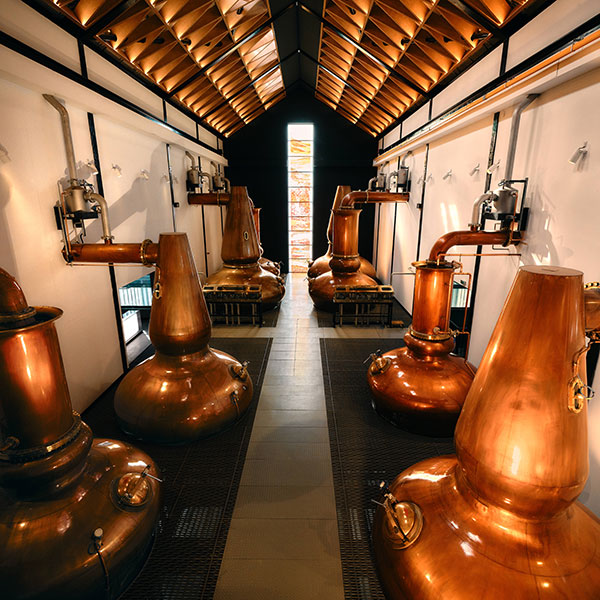
In order to take annual production capacity up to 9 million liters of pure alcohol (lpa), Forsyths Ltd made replicas of the eight stills in the old stillhouse. The new stillhouse has two pairs of 8,000-liter stills and two pairs of 16,000-liter stills. Originally, the Matheson-era distillery had two traditional Highland stills, which doubled to four in the early years of the Mackenzie era. Whyte & MacKay, under the supervision of Colonel HAC Mackenzie, installed two additional pairs of large stills in 1964 and 1966, identical in proportion to the Highland stills but scaled up to twice the size. Dalmore’s flat-topped wash stills are designed to influence the character of the low wines, as the increased copper contact leads to more reflux, essentially, tricking the stills into thinking they are taller than they are. Meanwhile, the necks of the spirit stills are fitted with water jackets filled with cold water, and the lyne arms lead to horizontal condensers. The water jackets are an unusual sight in Scotland—the setup looks a little like the neck of a champagne bottle bobbing out of an ice bucket—and they act like a pre-lyne arm shell and tube condenser, causing the recondensed liquid to fall back into the belly of the spirit still. Fettercairn, Dalmore’s sister distillery, has a similar system with cooling rings around the necks of the spirit stills; Fettercairn’s water jackets may be hidden from view, but the intention to promote reflux is just the same. Dalmore’s stills are all slightly different heights, and the lyne arms are different lengths and diameters, meaning they sit at different distances from the wall on the still room floor. It’s a headscratcher, but Dalmore’s idiosyncratic, unbalanced distillation creates slightly different styles of new make spirit from each pair of stills. The small stills produce a more malty character while the larger stills produce fruitier notes: the combined new make (it’s all vatted together before cask filling) is perfectly suited for long maturation in different cask types, and already demonstrates Dalmore’s signature notes of chocolate, orange, and warming spices.
After the stillhouse, you visit the cask gallery, with its display staves of Matusalem sherry, port pipes, and red wine casks in a suspended installation of six casks, with each pair showing one unfurled cask, and the other looking like it’s just been detonated from the inside. This room celebrates Dalmore’s partnerships with González Byass, Graham’s Port, and Château Mont-Redon, and the flavors they lend to the spirit. From the internal surface of the wine-soaked oak, to the croze groove, grain, patina, and hoop marks of every stave, the exhibit is tactile, stylish, and a creative way of letting guests explore maturation from the inside out. And then it’s on to Warehouse No. 1.
What Whiskies Were Tasted?
In the tasting room, whatever the hour, once you’re seated at the table, it somehow feels like it’s midnight and you’re having the night of your life. The whiskies are chosen from the principal collection and the distillery select range, but as the tour is bespoke, the drams can be tailored to the individual party. Let the concierge know if there’s a Dalmore you’ve always wanted to try when you make your booking, and before long, you could be sipping that rare whisky in Dalmore’s Highland home. After the tour, there are further refreshments served in Dalmore’s luxury boutique, where you can round off your visit with a little retail therapy. During Whisky Advocate’s visit, the following whiskies were poured in the tasting room:
- Dalmore 18 year old, 43%
- Dalmore Distillery Select 2007 17 year old Amarone & Port Cask Finishes, 45.8%
- Dalmore 19 year old Travel Retail Exclusive, 47%
- Dalmore Distillery Select 2000 24 year old Vintage Calvados Finish, 50.3%
Hunt the Stag
The 12-pointed royal stag that adorns each bottle of Dalmore was bestowed upon the first chieftain of Clan Mackenzie in 1263 by King Alexander III of Scotland as a reward for saving the king from the fury of a charging stag. The moment is immortalized in American artist Benjamin West’s 18th century painting, the largest painting held in the National Galleries of Scotland collection. Throughout the tour, there are a variety of Dalmore stags to spot, but see if you can hunt down all 12 points on the tour where the following stags can be seen:
- The Guardian Stag
- The Sunken Relief Stag
- The Pin Stag
- The Compass Stag
- The Uplifting Stag
- The Fire Stag
- The Embossed Stag
- The Glass Stag
- The Shadow Stag
- The Solid Silver Stag
- The Light Sculpture Stag
- The Red Stag
** Answers below (Spoiler Alert)
How to book The Dalmore Experience
The Dalmore Experience is bookable here and costs from £250 per person (approx. $340). The 3-hour experience runs twice a day, Monday to Friday, and can accommodate groups of 2–8 guests. Tours are private for you and your guests, and must be booked in advance. The Dalmore’s concierge team will contact the lead guest in advance to enquire about any requirements, whisky tasting preferences, or additional bespoke elements, such as transportation options or a whisky-paired dining experience, to ensure the experience meets the needs of every guest. The Dalmore Experience can be booked up to a year in advance, but the distillery’s private group policy means there is only capacity for 1,000–4,000 visitors each year. All visitors must be aged 18 years or older. Be aware, there is no other public access to Dalmore Distillery, the tasting room, or boutique.
Luxury scotch whisky tours have flourished this decade, and at $340 for an extensive, 3-hour whisky tour, The Dalmore Experience actually weighs in as one of the more affordable options. Equivalent luxury tours at Brora and Port Ellen cost $600, the Rosebank Revered tour is $400, and Macallan’s Distillery Experience, also a 3-hour private tour experience, costs $2,400 for up to 6 guests. However, unlike at Dalmore, all of these visitor centers also offer access through less expensive tours.
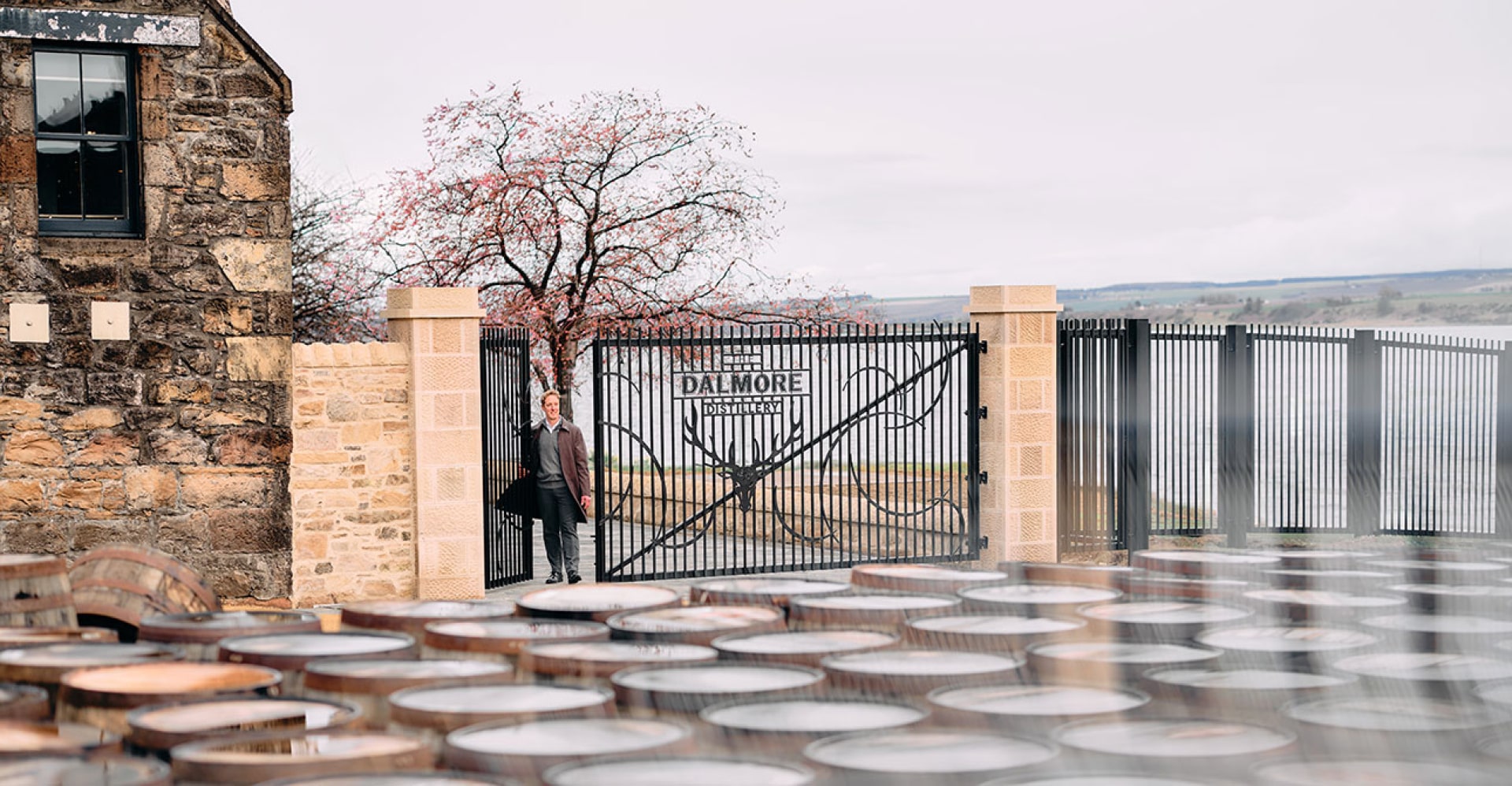
** Spoiler Alert: Where to find the 12 Dalmore stags: 1) Distillery Gates 2) Welcome lobby 3) Pin badge worn by each Dalmore host 4) At the center of the granite compass in front of the distillery 5) Malt barn elevator shaft 6) Glowing on the tasting room back wall 7) Tasting mat in the tasting room 8) Etched on to each tasting room copita glass 9) Lift up the crystal water glass to reveal the shadow cast on to the tasting mat through its base 10) Handcrafted silver stag by Hamilton & Inches, Edinburgh adorn the prestige rarities, such as The Dalmore 45 year old, in the tasting room cabinet beneath the Fire Stag 11) Revealed in front of the Uplifting Stag on departure from the tasting room – a true lightbulb moment 12) Woven into the luxurious throws and on the cocktail menu in the Dalmore boutique