
Octomore Returns With This Year's Release, Series 17
The famously smoky brand chimes in with a new quartet that dials back the peat
September 3, 2026 –––––– Danny Brandon
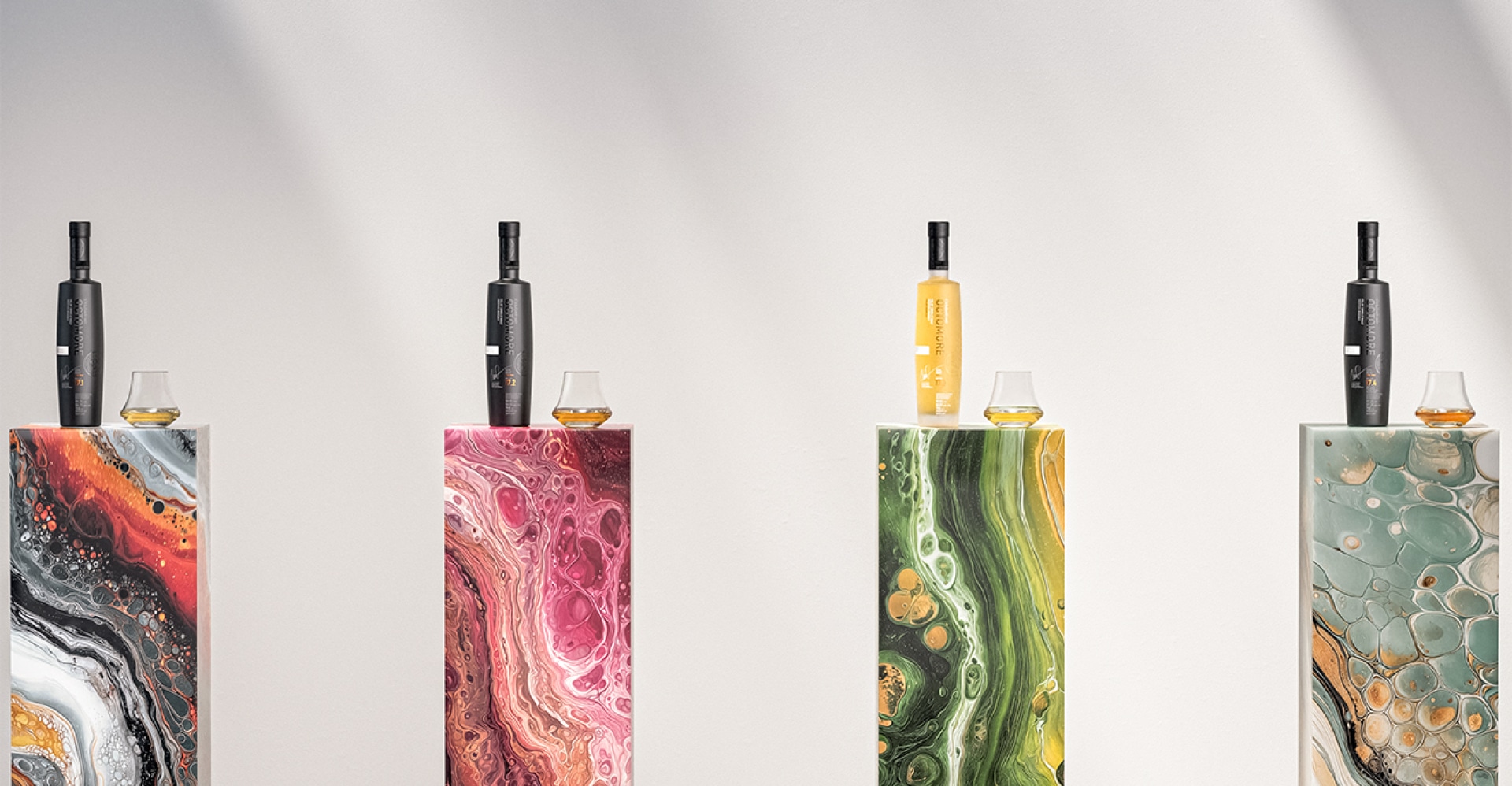
Islay whisky Octomore is famous for having some of the world’s highest peat levels. Distilled from heavily peated barley and bottled at relatively high proof, it has all the makings of a smoke bomb. But it’s in fact more complex than that, and stands out more for the purity of its spirit than its high smoke content. This year’s Octomore release, the four-bottle Series 17, uses considerably less peat than previous collections.
In keeping with tradition, the first single malt in the release, (labeled as “.1”) serves as a reference point for the rest of the series. 17.1 was distilled entirely from Concerto barley grown on the Scottish mainland that was peated to 81 phenol parts per million (PPM). It was aged 5 years in first-fill bourbon barrels, and bottled at 59.7% ABV.
Next comes 17.2, which focuses on maturation. It uses the same distillate as 17.1 (Concerto barley peated to 81 PPM), but it was parceled then aged in a completely different arrangement of casks. This one spent 4 years in French oak barrels that previously held California red wine and were briefly used to finish bourbon. After that, the whisky was finished for 1 year in first-fill port barriques. It was bottled just a touch lower at 59.5% ABV. According to the distillery, this is the first time Octomore has been aged in this arrangement of casks.
Octomore 17.3 puts local grain in the spotlight, showcasing Concerto barley from one harvest that was grown on a single field on Octomore Farm. This one has the highest peat content for the 2026 lineup at 132.1 PPM. It also has a fairly interesting maturation, having been matured full-term in a mix of first-fill bourbon, second-fill Ribera Del Duero Spanish wine, sauternes, ice wine, and syrah casks. It was bottled at 60.9% ABV.
For the first time, Octomore has released a “.4” edition in the U.S., with previous expressions having been set aside as distillery exclusives or for specific markets abroad. 17.4 also taps mainland Concerto barley, though it has a higher peat content of 108.2 PPM. At 7 years old, it’s also the oldest whisky in this year’s collection, having been aged in first-fill oloroso casks and finished in virgin French oak. It was bottled at 62.6% ABV.
Octomore’s peat content varies year to year, but they almost always fall somewhere in the triple digits. The high-water mark for the series is 2017’s Octomore 8.3, which had an eye-watering peat content of 309.1 PPM. But this year’s .1 and .2 expressions use notably less peat than previous years, with some of the lowest PPMs we’ve seen from the brand in recent memory. As master blender Adam Hannett explains, smoke is one of the few production aspects that the distillery doesn’t have complete control over, with the work being carried out at a malting house in Inverness. He says it's a fickle process that poor weather can affect—Scotland’s strong winds can disrupt the chimney’s airflow, raise the temperature, speed up the process, and ultimately reduce peat content.
The drop in PPM might upset some fans of the series, but double-digit peat levels aren’t unprecedented at Octomore. As Hannett points out, the brand’s first-ever production run was even lower at 80 PPM. There’s also Octomore 13.4, an experimental release that was aged for 3 years in virgin French oak, and had a PPM of 88. While the newcomers seem lightly peated by Octomore standards, it’s worth mentioning that they’re still considerably smoky when looking at the wider scotch landscape. For reference, 17.1 and 17.2 have about twice the PPM as Bruichladdich’s own Port Charlotte 10, and about four times more peat than Highland Park 12.
Octomore 17.1, 17.2, and 17.3 are available online and at select retailers nationwide for suggested prices of $205, $245, and $280, respectively. 17.4 is expected to release exclusively online on October 1st, with a suggested retail price of $250.